
DATA PULSE
SEMICONDUCTOR Inside Samsung’s Semiconductor Fab Strategy: How Pyeongtaek P1–P6 Are Built, Operated and Expanded MARINE & ENERGY China Builds More Ships, Korea Still Powers Much of the Fleet: Low-Speed Engines Meet the Battery-Hybrid Era ENERGY & EV Beyond the EV Price War: Could Robots Give Korean and Japanese Battery Makers a New Advantage? SEMICONDUCTOR Japan vs. Korea Semiconductor Equipment Ecosystems: From Lithography to Plasma, Chillers and Sub-Fab Systems DATA & MARKET Korea’s AI Chip Bet: Rebellions, FuriosaAI and the Korea–Japan Data Advantage AI & HUMANITY From GitHub to Novelhaus: Can Human Imagination Become a Shared Platform? AI & HUMANITY From the Human Brain to AGI: The 100-Year Journey Behind Modern AI AI INFRASTRUCTURE From A100 to Rubin and Beyond: NVIDIA’s GPU Roadmap Is Rewriting AI Power and Cooling Infrastructure

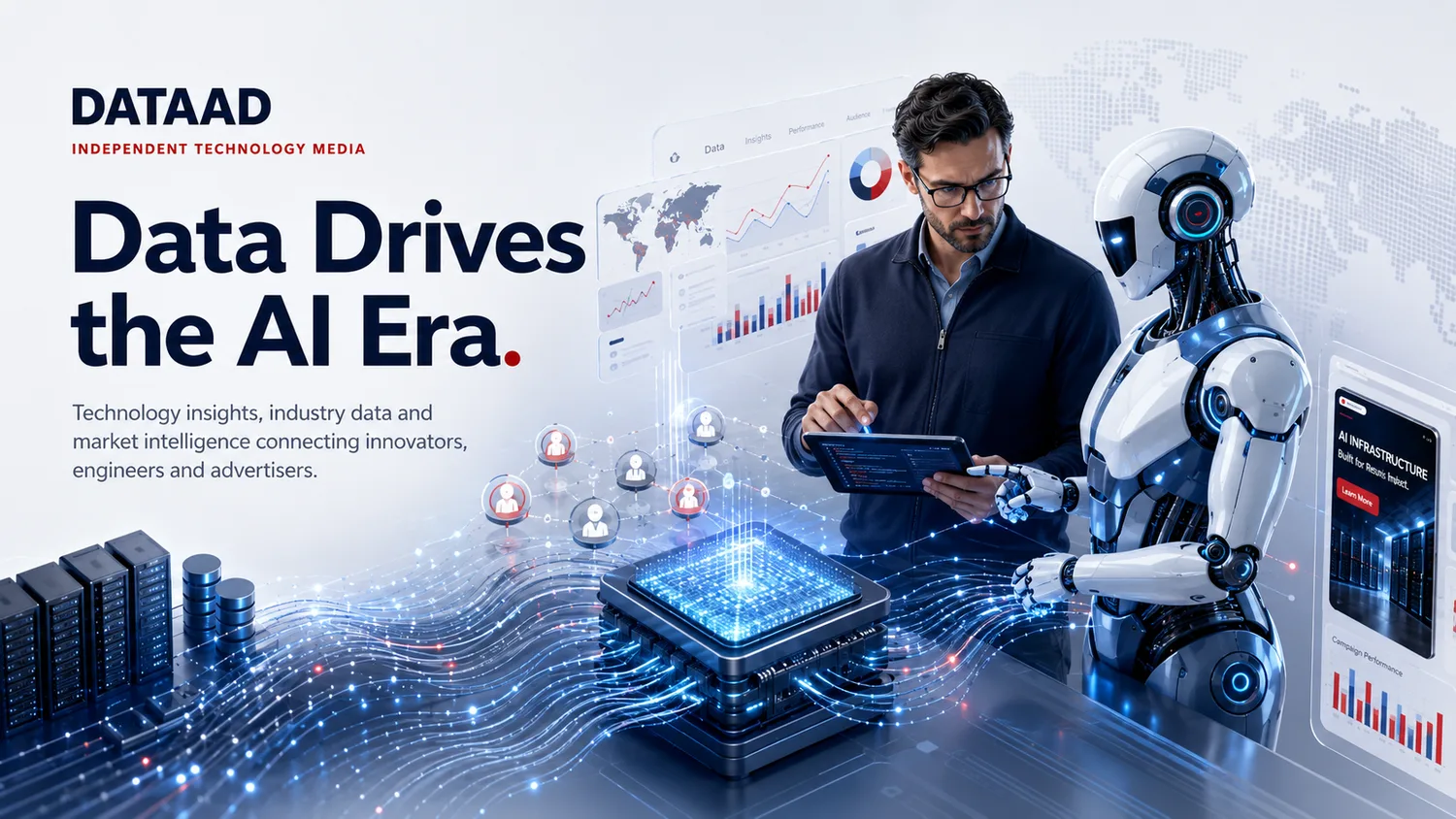
INDEPENDENT TECHNOLOGY MEDIA

Data Drives
the AI Era.

Technology insights, industry data and market intelligence connecting innovators, engineers and advertisers.

Built on 30+ years of real industrial field experience and a global network spanning the Americas, Asia and Europe, DATAAD delivers grounded insight you can trust.

DATAINSIGHTAI + HUMANMARKET
DATAFacts, benchmarks and signals
INSIGHTTechnical context that matters
PHYSICAL AIHumans, robots and real-world systems
MARKETTechnology meets business opportunity

EDITORIAL FOCUS

Understand what is changing.

From AI data centers to physical AI and human creativity, DATAAD follows the infrastructure, technologies and markets behind the next computing era.

Inside Samsung’s Semiconductor Fab Strategy: How Pyeongtaek P1–P6 Are Built, Operated and Expanded

LATEST INSIGHTS

Learn what matters.

Explore topics →
China Builds More Ships, Korea Still Powers Much of the Fleet: Low-Speed Engines Meet the Battery-Hybrid Era
Insight · Marine & Energy

China Builds More Ships, Korea Still Powers Much of the Fleet: Low-Speed Engines Meet the Battery-Hybrid Era

China now dominates global shipbuilding volume, but South Korea remains extraordinarily powerful in the large low-speed two-stroke engines that propel the world's container ships, LNG carriers and tankers. Japan retains a smaller but technologically important engine industry, including independent engine IP and next-generation ammonia and hydrogen development. At the same time, battery-electric and hybrid propulsion is expanding rapidly. LFP batteries are gaining ground in marine applications because of safety, cycle life and cost, but NMC and LTO remain important where weight, volume or high-power charging matters. For large ocean-going ships, the future is therefore unlikely to be “battery versus engine.” It is more likely to be engine plus battery plus power electronics, increasingly managed as one integrated marine power system.

Aug 23, 2026 · 13 min read
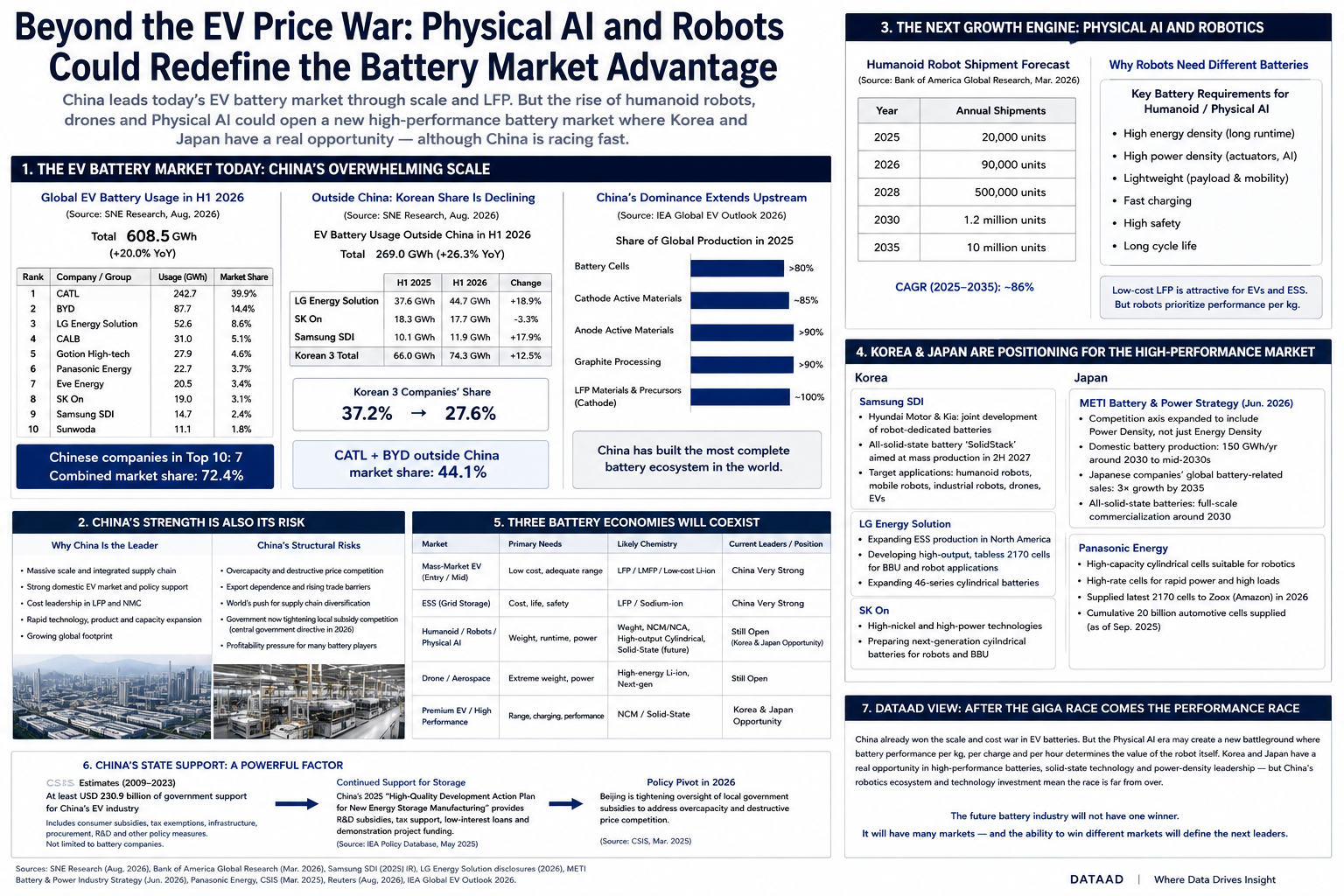
Beyond the EV Price War: Could Robots Give Korean and Japanese Battery Makers a New Advantage?
Insight · Energy & EV

Beyond the EV Price War: Could Robots Give Korean and Japanese Battery Makers a New Advantage?

China overwhelmingly leads today’s EV battery market through scale, LFP chemistry and an integrated supply chain. But the rise of humanoid robots, drones and Physical AI could create a different battery market where weight, power density, runtime, fast charging and safety matter more than the lowest cost per kWh. That shift could open a new high-value opportunity for Korean and Japanese battery makers — although China’s rapidly growing robotics ecosystem means the outcome is far from decided.

Aug 23, 2026 · 12 min read
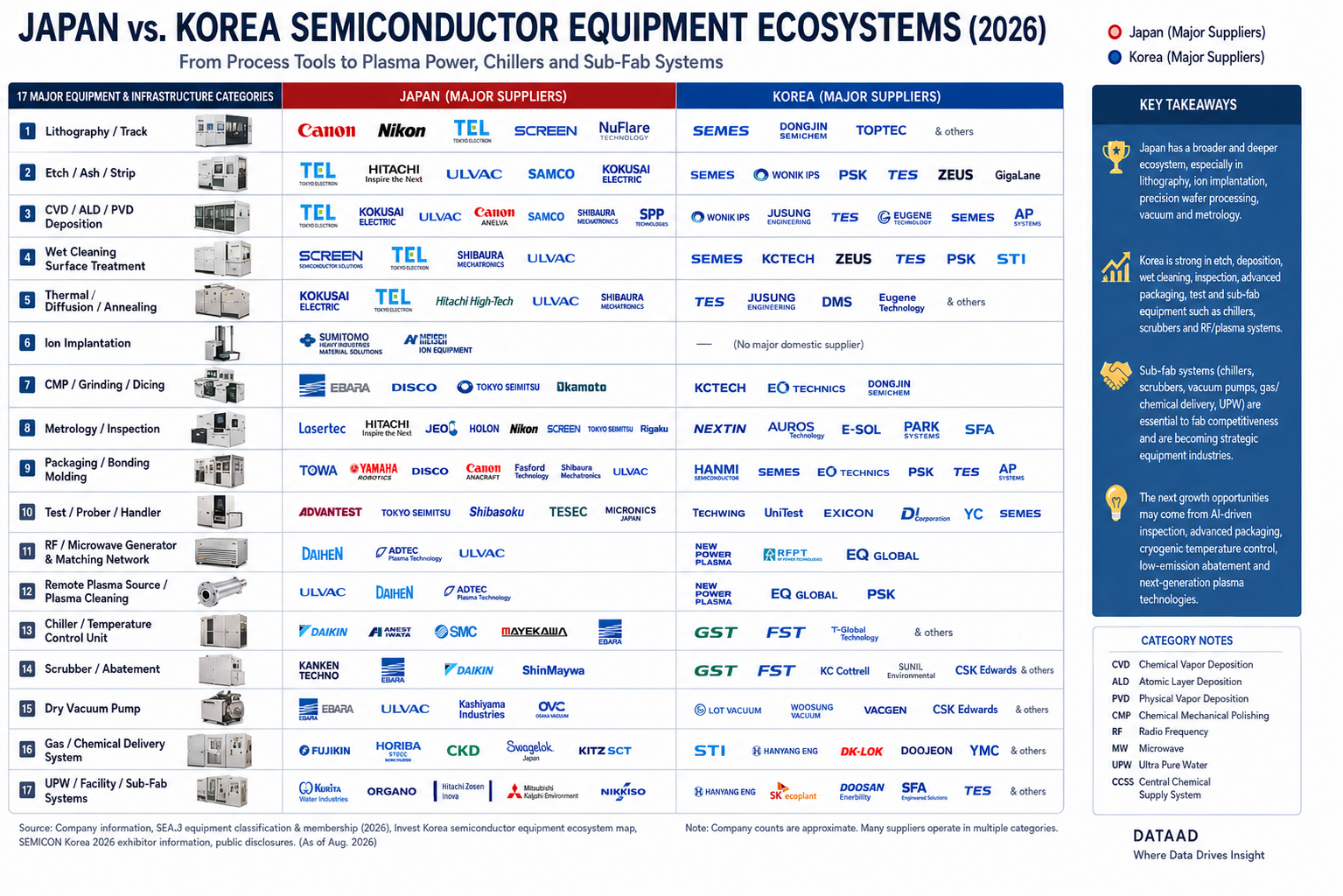
Japan vs. Korea Semiconductor Equipment Ecosystems: From Lithography to Plasma, Chillers and Sub-Fab Systems
Insight · Semiconductor

Japan vs. Korea Semiconductor Equipment Ecosystems: From Lithography to Plasma, Chillers and Sub-Fab Systems

South Korea is one of the world’s largest semiconductor manufacturing centers, while Japan retains one of the deepest semiconductor equipment ecosystems in the world. Looking beyond lithography, etching and deposition to RF generators, remote plasma sources, chillers, scrubbers, vacuum pumps and chemical delivery systems reveals a more complex picture: Japan remains broader in precision and specialized equipment, while Korea has developed surprisingly strong capabilities in plasma power, thermal control, abatement and other sub-fab technologies built around Samsung Electronics and SK hynix.

Aug 23, 2026 · 12 min read
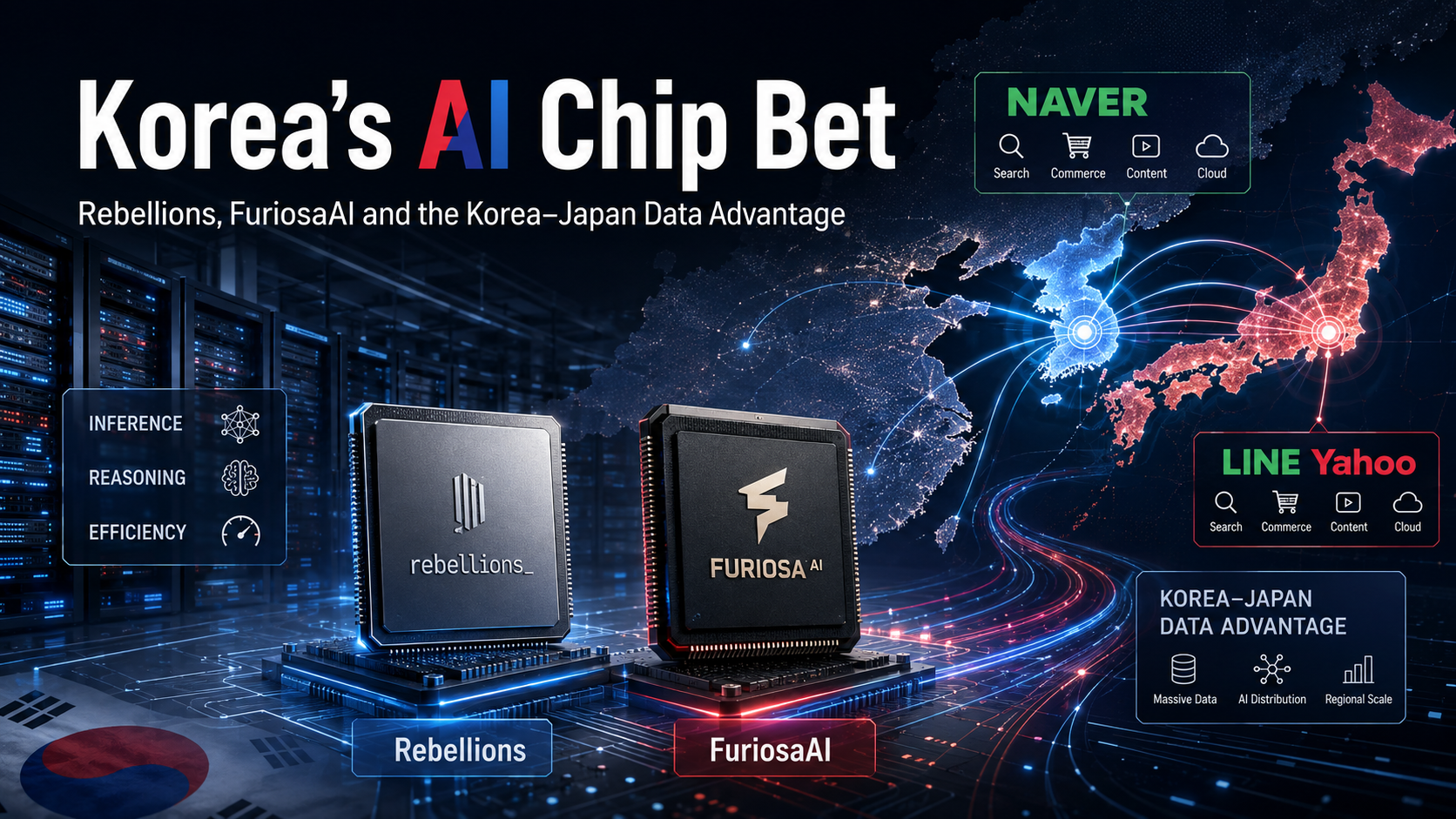
Korea’s AI Chip Bet: Rebellions, FuriosaAI and the Korea–Japan Data Advantage
Insight · Data & Market

Korea’s AI Chip Bet: Rebellions, FuriosaAI and the Korea–Japan Data Advantage

As AI moves from model training toward massive-scale inference and agentic AI, Korea may have a larger opportunity than many expect. Rebellions and FuriosaAI are emerging as serious inference-chip challengers, while NAVER and the LINE–Yahoo ecosystem provide something equally important: real-world data, distribution and access to hundreds of millions of Asian users.

Aug 23, 2026 · 6 min read
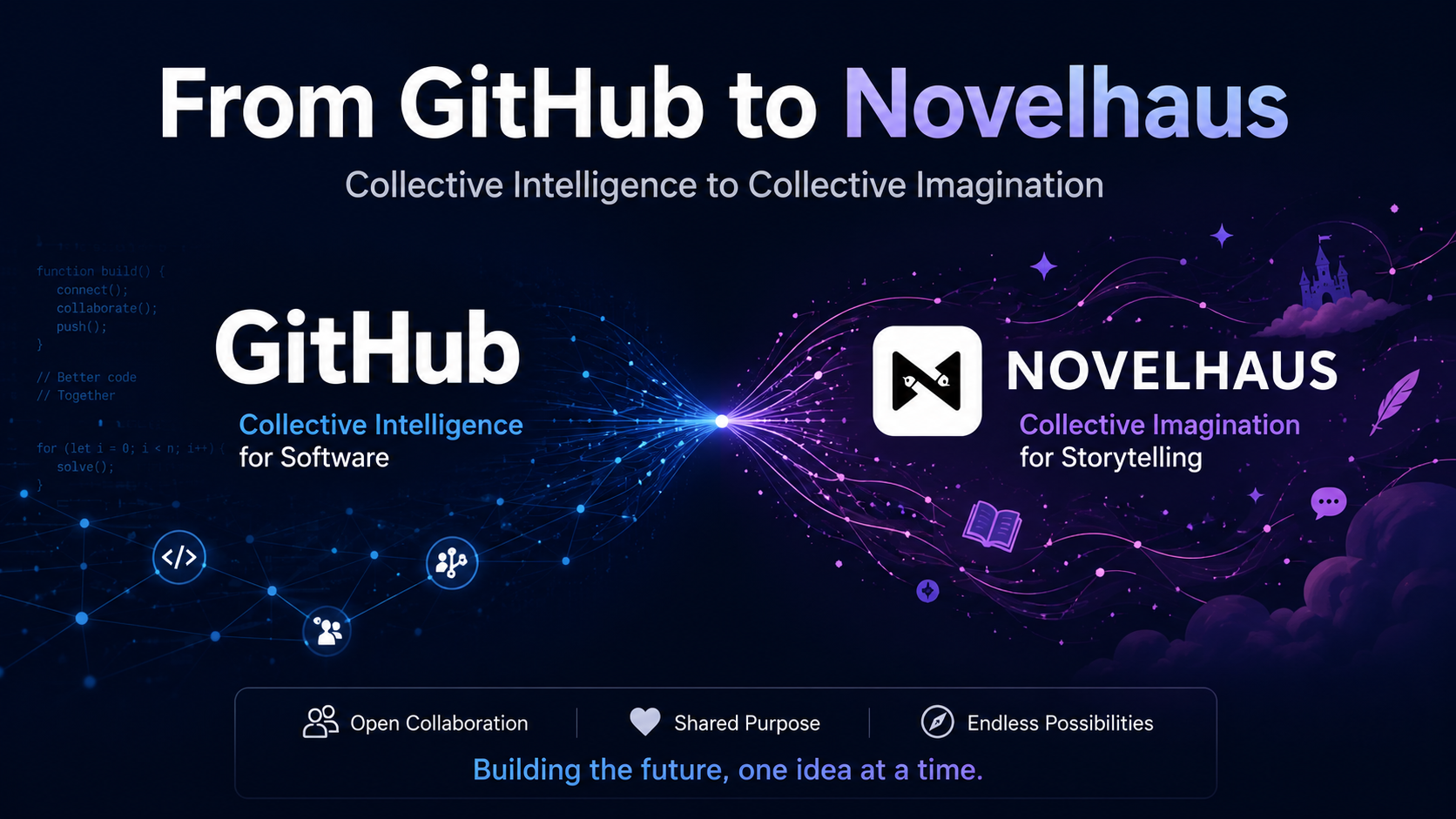
From GitHub to Novelhaus: Can Human Imagination Become a Shared Platform?
Insight · AI & Humanity

From GitHub to Novelhaus: Can Human Imagination Become a Shared Platform?

GitHub changed software by allowing millions of people to share, modify and improve code together. But what if the same idea were applied not to software, but to human imagination? In the AI era, platforms such as Novelhaus may point toward a new model in which stories, characters and entire fictional worlds evolve through collective creativity supported by artificial intelligence.

Aug 22, 2026 · 5 min read
From the Human Brain to AGI: The 100-Year Journey Behind Modern AI
Insight · AI & Humanity

From the Human Brain to AGI: The 100-Year Journey Behind Modern AI

Modern AI did not begin with Geoffrey Hinton or Google's Transformer. It grew from more than a century of neuroscience, mathematics and computer science. From the discovery of neurons to deep learning, Transformers and reasoning models, humanity has been slowly recreating pieces of its own intelligence in machines. The next great question is what happens when human imagination combines with AI-scale knowledge.

Aug 22, 2026 · 7 min read

DATA DESK

Turn numbers into context.

DATAAD is designed to grow beyond articles into practical comparisons, benchmarks and market intelligence.

01

Technology Benchmarks

Power density, cooling conditions, materials, interfaces, performance ranges and system comparisons.

02

Market Signals

Adoption trends, industry moves, new platforms, events and emerging commercial opportunities.

03

Decision Guides

Clear technical guides for engineers, operators and buyers evaluating next-generation technology.

AI + HUMANITY

AI is not only about machines.

Physical AI will change how machines work in the real world. Generative AI will also change how people create, write, design and participate in new markets. DATAAD covers both sides without losing its technical focus.

Explore AI & Humanity →
DATAbecomes intelligence+HUMANbecomes possibility