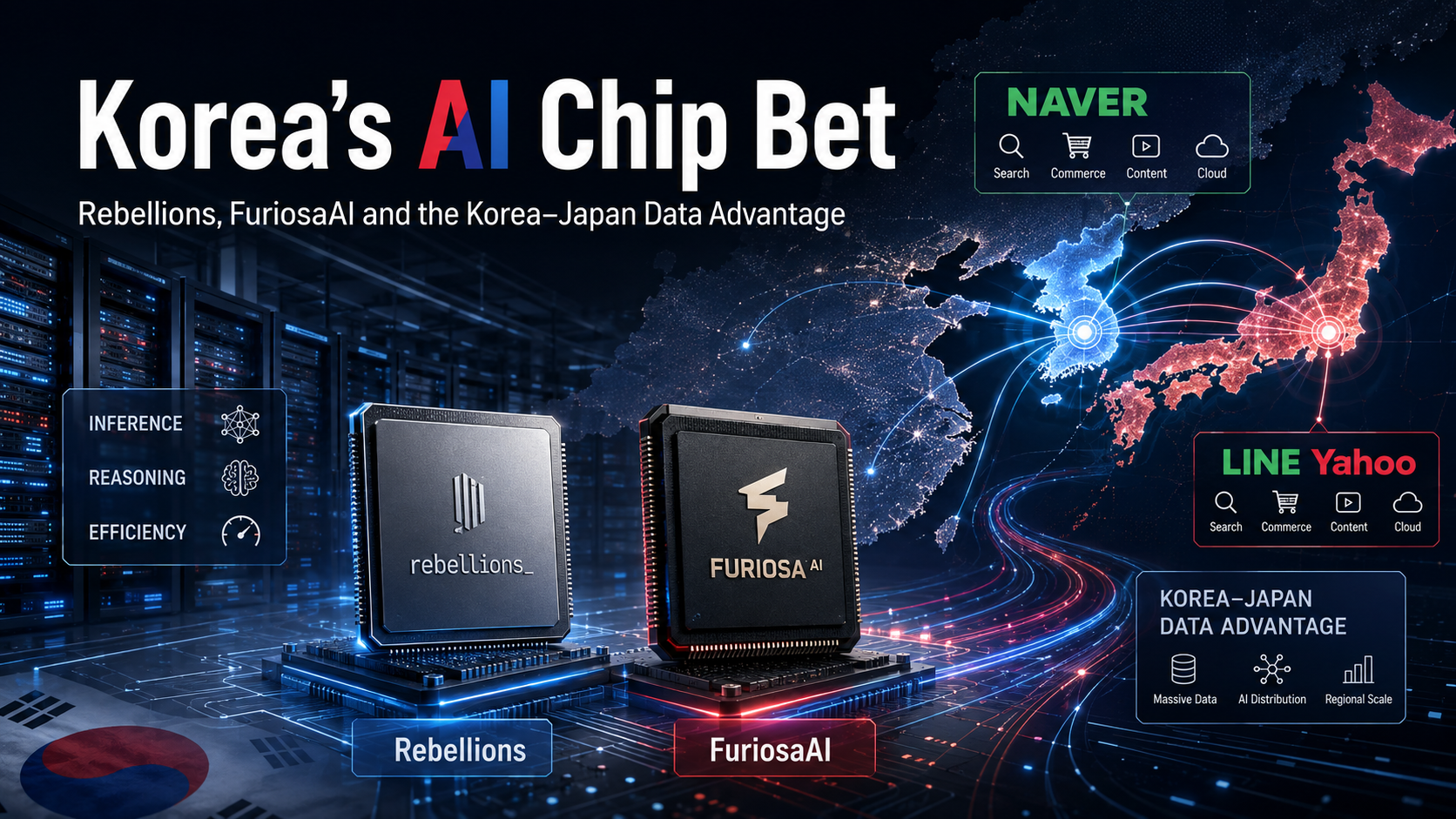
Korea’s AI opportunity may begin with inference
The global AI race has so far been dominated by NVIDIA and the enormous GPU clusters used to train frontier models. But the economics of AI are changing.
Reasoning models and AI agents repeatedly call models, tools and databases before producing an answer. This can create enormous token volumes. As AI moves from experimentation into everyday commercial services, inference efficiency — performance per watt, cost per token and infrastructure utilization — becomes increasingly important.
This is exactly where two Korean semiconductor companies, Rebellions and FuriosaAI, are positioning themselves.
They do not need to replace NVIDIA across the entire AI market to become important global companies. Capturing even part of the rapidly expanding inference infrastructure market could be a major opportunity.
Rebellions: From NPU chipmaker to AI infrastructure company
Rebellions is rapidly moving beyond being a semiconductor startup.
Its Rebel100 platform uses a four-chiplet architecture with UCIe interconnects and HBM3E memory. The company lists up to 2 PFLOPS of FP8 compute, 144GB of HBM3E and support for widely used software frameworks including PyTorch, vLLM and Triton.
More important than the chip specifications, however, is the company's direction.
Rebellions raised $400 million in a pre-IPO round in March 2026 at a valuation of roughly $2.34 billion and is expanding production of Rebel100 while preparing for global expansion and an eventual IPO.
It is also moving vertically through the AI infrastructure stack.
The company acquired inference-optimization specialist SqueezeBits in June, adding model optimization and inference serving to its hardware business. It is cooperating with Arm and SK Telecom on sovereign-AI infrastructure and with Giga Computing on server and rack-scale systems.
The strategy is becoming clear:
Chip → accelerator card → server → rack → inference software → AI infrastructure.
That is much more ambitious than simply selling NPUs.
FuriosaAI: Efficient inference for the agentic era
FuriosaAI is taking a somewhat different path.
Its second-generation RNGD accelerator entered volume production in 2026, with FuriosaAI announcing an initial delivery of 4,000 accelerators. The company is focusing heavily on large-language-model and agentic-AI inference.
Commercial deployment is now becoming visible.
Samsung SDS launched an RNGD-powered NPU-as-a-Service offering on Samsung Cloud Platform in July 2026, allowing enterprises and public-sector customers to access FuriosaAI accelerators without owning dedicated hardware.
FuriosaAI has also partnered with LG U+ around a sovereign-AI appliance combining RNGD with LG's EXAONE model ecosystem, while expanding RNGD infrastructure into Europe through an Equinix data center in Lisbon.
Its longer-term ambitions are even larger.
In May, FuriosaAI announced a partnership with Broadcom to develop its third-generation accelerator as a scale-up inference platform designed for large agentic-AI systems and hyperscale environments.
The company's independence is also notable. FuriosaAI reportedly rejected an approximately $800 million acquisition proposal from Meta in 2025, choosing instead to continue developing the company independently.
Korea has something most AI-chip startups do not
Building a competitive AI chip is extremely difficult.
But Korea has an unusual combination of assets surrounding its AI-chip startups.
It has Samsung Electronics and SK Hynix, a world-leading memory ecosystem, advanced semiconductor manufacturing and packaging capabilities, major telecom operators, cloud companies, electronics manufacturers and some of the world's most sophisticated data-center customers.
Rebellions can work with SK Telecom. FuriosaAI can validate systems with LG and Samsung SDS.
This creates a domestic environment where new accelerators can move from silicon to servers and then into production workloads relatively quickly.
Korea is also dramatically expanding AI and semiconductor investment. The government and major Korean companies have announced enormous long-term investments across semiconductors, HBM, AI infrastructure and data centers.
Yet Korea still has major weaknesses.
The United States dominates frontier AI models, hyperscale cloud infrastructure and AI software ecosystems. NVIDIA's CUDA ecosystem remains exceptionally difficult to challenge. Korea also lacks the scale of cloud capital available to Microsoft, Google, Amazon and Meta.
Therefore, Korea's realistic opportunity may not be to reproduce the American AI ecosystem.
It may be to build a different one.
The overlooked advantage: NAVER, LINE and Yahoo! JAPAN
AI competition is not only about chips and models.
It is increasingly about data and distribution.
NAVER possesses something extremely difficult to recreate: years of user interaction across search, shopping, local information, UGC, advertising, payments and merchant services.
NAVER itself describes its AI strategy as a cycle in which proprietary data from areas including UGC, shopping and local services improves AI, while AI improves those services. Search can increasingly connect directly with shopping, reservations and payments.
Its second-quarter 2026 results already show AI becoming commercially relevant. NAVER reported that AI-related improvements contributed more than 60% of advertising revenue growth, while the company continues investing heavily in AI infrastructure.
Japan provides another enormous strategic asset.
LY Corporation operates LINE and Yahoo! JAPAN together with a broad ecosystem that includes PayPay and numerous commerce and financial services.
As of March 2026, LINE reported approximately 100 million monthly active users in Japan, 22 million in Taiwan and 54 million in Thailand, giving it an unusually strong consumer distribution network across some of Asia's most important digital economies.
Yahoo! JAPAN also recorded roughly 107 million daily unique browsers according to LY's FY2025 disclosure, although this metric should not be directly added to LINE users because users and devices overlap.
LY Corporation is already moving this distribution network toward AI. Its new Agent i, launched in April 2026, connects AI-agent functionality directly with LINE and Yahoo! JAPAN and is intended eventually to move beyond answering questions toward helping users execute tasks.
That transition could be strategically significant.
A Korea–Japan AI economic zone?
NAVER and Japan's LINE Yahoo ecosystem also retain an important corporate connection.
NAVER and SoftBank each own 50% of A Holdings, while A Holdings holds approximately 62% of LY Corporation.
However, this does not mean Korean NAVER data and Japanese LINE Yahoo data are one freely shared database.
Privacy regulation, cybersecurity requirements, corporate governance and national data policies place important boundaries around how data can be stored, transferred and used.
That distinction matters.
The strategic value is not necessarily in physically combining every dataset.
The larger opportunity is creating an interoperable Korea–Japan AI ecosystem in which AI models, inference infrastructure, commerce platforms and local services can operate close to the users and data of each market.
This model could then extend toward Taiwan, Thailand and other Asian economies where LINE already has strong distribution.
DATAAD View: Korea should not try to become another America
The United States controls much of today's frontier AI model and GPU ecosystem. China has enormous domestic data, internet platforms and manufacturing scale.
Korea is unlikely to defeat either country by copying them directly.
But Korea possesses a different combination of assets:
AI accelerators + HBM memory + semiconductor manufacturing + telecom + cloud + NAVER data + Korean industrial data + LINE/Yahoo distribution in Japan and Asia.
This combination deserves more attention.
Rebellions and FuriosaAI could become the computing layer.
Samsung, SK, LG, telecom operators and cloud providers could provide infrastructure and enterprise deployment.
NAVER could provide Korean search, commerce, local and payment intelligence.
LINE and Yahoo! JAPAN could provide one of Asia's largest consumer distribution channels.
The result would not necessarily be a Korean NVIDIA.
It could be something broader: an Asian sovereign-AI infrastructure and service ecosystem optimized for inference rather than simply another GPU company.
For Korea, the critical question over the next five years may therefore not be:
"Can Korea build a chip faster than NVIDIA?"
A more important question may be:
"Can Korea connect its chips, memory, data, AI services and its strategic links with Japan into one competitive AI ecosystem?"
If the answer becomes yes, Korea's position in the global AI industry could be substantially larger than its current share of the AI accelerator market suggests.