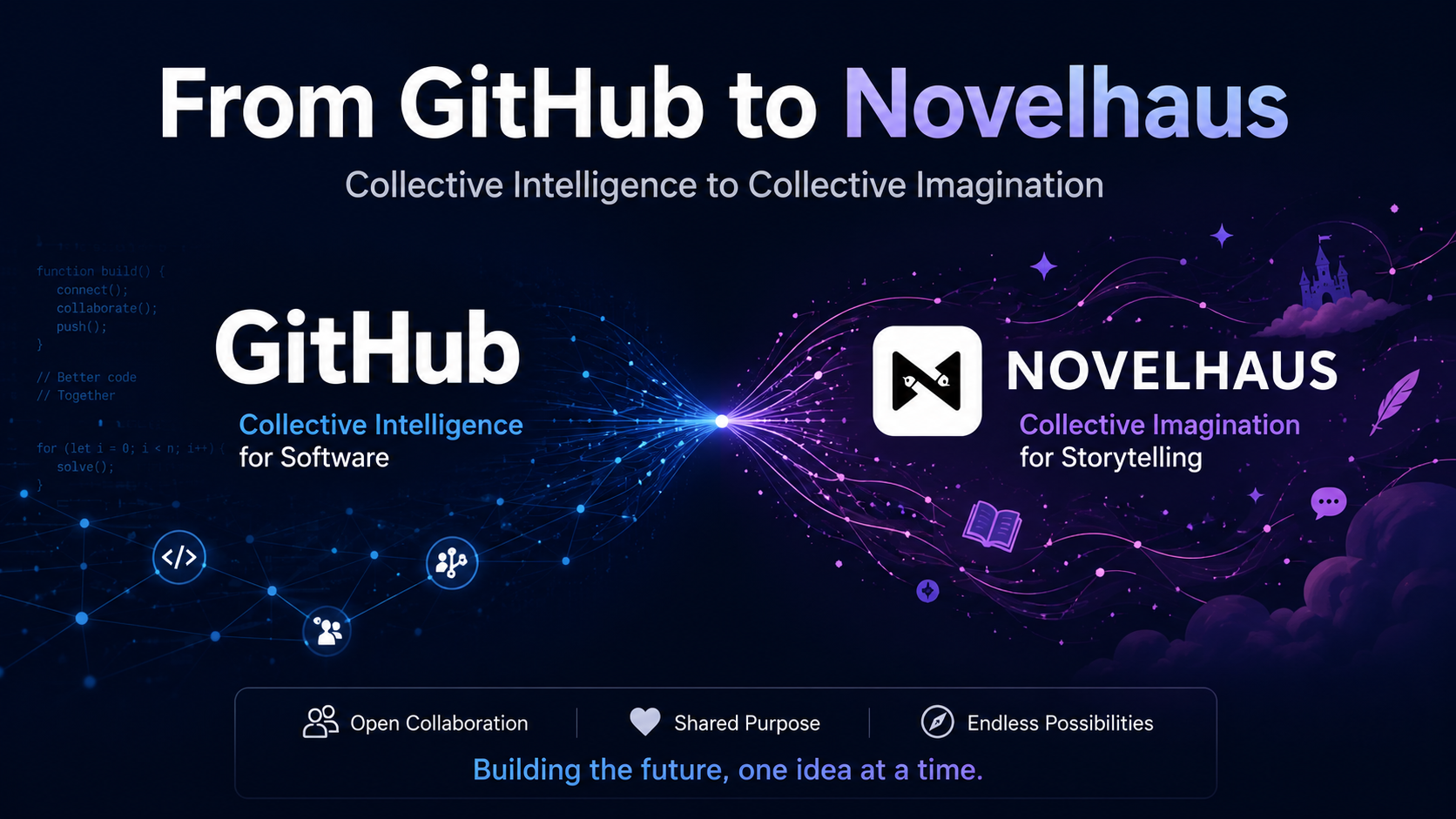
GitHub Organized Collective Intelligence
GitHub's importance is not simply that it stores computer code.
Its real innovation is that knowledge can evolve collectively.
One person creates something.
Another person finds a problem.
Someone proposes an improvement.
Others test it.
The project becomes better.
And future creators do not have to start again from zero.
This simple mechanism helped transform software development.
Thousands of people who have never met can work around the same project.
Knowledge becomes cumulative.
GitHub can therefore be described as a platform for collective technical intelligence.
But technology is only one form of human creation.
What about imagination?
Stories Have Traditionally Belonged to One Author
For most of human history, storytelling followed a relatively simple structure.
A writer imagined a story.
The writer created characters.
The writer decided what happened next.
Readers consumed the finished work.
Books, films and television changed the scale of distribution, but the basic relationship remained largely the same.
One creator → One finished work → Many readers
The internet started changing this.
Readers became commenters.
Fans began creating alternative stories.
Online communities discussed characters and possible endings.
But the original work itself usually remained controlled by a small number of creators.
AI may now make another model possible.
What If Imagination Worked More Like GitHub?
Imagine a story beginning with only a simple idea.
A woman wakes up on Mars and discovers that everyone remembers a war that she believes never happened.
One person creates the original concept.
Another develops the history of Mars.
Someone else creates a new character.
Another contributor proposes an alternative episode.
Readers evaluate the ideas.
The strongest concepts continue developing.
AI helps connect the characters, history and previous episodes into a coherent narrative.
Instead of one person having to create everything, imagination begins to accumulate.
The structure starts to resemble GitHub.
| GitHub | Novelhaus Concept |
|---|---|
| Repository | Story or fictional world |
| Contributor | Writer or idea creator |
| Commit | New episode or modification |
| Branch | Alternative storyline |
| Community Review | Reader evaluation |
| Software Tools | AI writing and story tools |
| Source Code | Human imagination |
The products are completely different.
But the underlying philosophy is surprisingly similar.
Collective Intelligence vs. Collective Imagination
GitHub could be described as:
Collective Intelligence for Technology
Novelhaus could become:
Collective Imagination for Storytelling
That distinction may become increasingly important in the AI era.
AI already has access to enormous amounts of human knowledge.
It can help with language.
History.
Science.
Geography.
Character development.
Story structure.
Translation.
Research.
But knowledge alone does not automatically create a great story.
Someone still has to ask:
What if?
What if humans lived underwater?
What if a robot remembered a previous life?
What if Mars became independent from Earth?
What if death could be delayed but only for the rich?
These questions do not begin with databases.
They begin with imagination.
AI Does Not Have to Replace the Writer
Much of today's debate asks whether AI will replace writers.
That may be the wrong question.
A more interesting possibility is that AI allows far more people to become storytellers.
Someone may have an extraordinary concept but lack professional writing skills.
Another person may understand history but not know how to structure a novel.
Someone else may create fascinating characters but struggle with English.
AI can reduce these barriers.
The human supplies the original imaginative spark.
AI helps organize, research, translate and develop it.
The relationship could become:
Human Imagination → Community Contribution → AI Development → New Story
AI becomes an amplifier rather than the origin of imagination.
From 0.2% of Humanity to 10%
Historically, only a tiny percentage of people have attempted to write and publish serious fiction.
Writing a novel requires enormous time, discipline and technical ability.
But billions of people imagine stories.
They dream.
They remember unusual experiences.
They ask strange questions.
They create characters in their minds.
Most of those ideas disappear.
AI could change that.
If future tools reduce the technical difficulty of writing, perhaps storytelling participation could expand dramatically.
The important shift would not simply be producing more books.
It would mean capturing a much larger percentage of humanity's imagination.
Imagine if 10% of humanity contributed stories, ideas, characters, memories or fictional worlds.
That could create a creative dataset unlike anything that has existed before.
Not simply information about what humanity knows.
But information about what humanity imagines.
Why This Matters Beyond Entertainment
Human imagination has always preceded technological reality.
Humans imagined flying long before airplanes existed.
They imagined traveling to the Moon long before Apollo.
Science fiction imagined robots, artificial intelligence, video communication and virtual worlds decades before many of them became practical.
Stories are not simply entertainment.
They are simulations of possible futures.
A platform that accumulates imagination could therefore eventually become more than a publishing platform.
Scientists could discover unexpected ideas.
Designers could explore new societies.
Engineers could encounter strange concepts that inspire real products.
AI could analyze millions of fictional scenarios and find patterns that humans overlooked.
The boundary between storytelling and innovation could become increasingly blurred.
The GitHub Lesson
GitHub teaches an important lesson.
Human progress accelerates when people do not have to begin everything from zero.
Software developers inherit the work of previous developers.
Future storytellers may similarly inherit worlds, characters and ideas created by previous contributors.
But there is an important difference.
Code normally seeks a correct result.
Stories do not.
There may be hundreds of equally fascinating directions.
One character can survive in one version and die in another.
One civilization can collapse in one storyline and conquer the solar system in another.
That makes collective imagination fundamentally different from collective coding.
And perhaps even more expansive.
DATAAD View
GitHub helped humanity organize and share technical intelligence.
The next generation of platforms may begin organizing something much harder to measure:
human imagination.
Novelhaus is one possible experiment in that direction.
Its potential is not simply to use AI to write novels faster.
The larger idea is to create a place where human ideas can accumulate, interact and evolve.
One person begins a story.
Another expands it.
Thousands imagine alternatives.
AI helps transform those fragments into coherent worlds.
GitHub showed that millions of people can collaboratively build software far larger than any individual could create alone.
What happens if millions of people begin building fictional worlds in the same way?
The most valuable resource of the AI age may not ultimately be data.
It may be the combination of two things:
AI's accumulated knowledge and humanity's unlimited imagination.
GitHub organized collective intelligence for software.
Perhaps the next great platform will organize collective imagination for humanity.