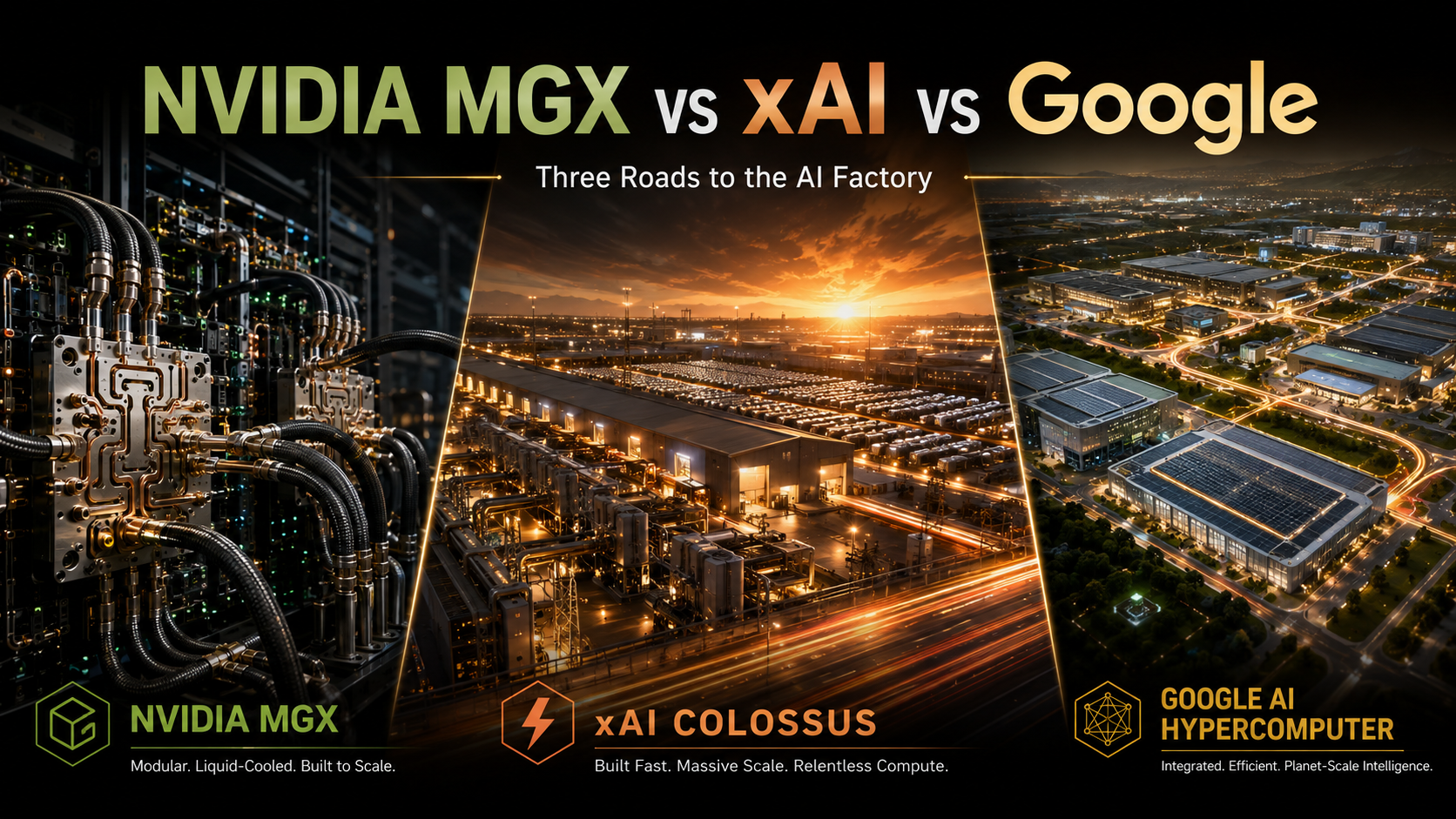
Three Different Ways to Build the AI Factory
In 2026, it is becoming increasingly difficult to understand the AI data center market simply by asking which company owns the most GPUs.
NVIDIA, xAI and Google are all building infrastructure for extremely large-scale artificial intelligence, but their approaches are fundamentally different.
NVIDIA is building the platform and architecture that allows the global industry to construct AI factories. xAI is demonstrating how quickly enormous GPU infrastructure can be deployed in the real world. Google is vertically integrating its own AI accelerators, networking, software and data centers into what it calls an AI Hypercomputer.
These three approaches may provide a useful picture of how the next generation of AI data centers will evolve.
1. NVIDIA MGX: Standardizing the AI Factory
First, NVIDIA MGX should not be understood as a single AI data center.
MGX is a modular reference architecture designed to help server manufacturers, system integrators and data center operators build different types of accelerated computing systems using a common platform.
The strategy is important because NVIDIA does not need to build every AI data center itself.
Instead, it is creating an ecosystem that connects:
- GPU and CPU computing
- NVLink and high-speed networking
- Rack architecture
- Power distribution
- Storage
- Liquid cooling
- OEM and ODM manufacturing
The result is an architecture that can be adopted by server manufacturers and infrastructure companies around the world.
With newer rack-scale systems, cooling and power infrastructure are becoming much more tightly integrated into the server architecture itself.
NVIDIA's latest infrastructure direction includes fully liquid-cooled rack designs and warm-water cooling concepts with inlet temperatures reaching approximately 45°C for certain next-generation architectures.
At the same time, NVIDIA is also promoting future 800 VDC power distribution concepts as rack power density moves toward extremely high levels.
This suggests an important transformation.
Cooling and electrical distribution are no longer secondary facility systems installed after the server has been designed. They are increasingly becoming part of the computing architecture itself.
NVIDIA's strategy can be summarized as: Build the standard for the AI Factory.
Reference: NVIDIA MGX Platform
2. xAI Colossus: Deployment Speed Becomes an Architecture
xAI has taken a very different approach.
The most important characteristic of xAI's Colossus infrastructure in Memphis is not the creation of a new server standard. It is the speed at which large amounts of AI compute can be physically installed and expanded.
xAI has described the initial Colossus system as having been built in approximately 122 days, followed by another rapid expansion phase that pushed the system toward approximately 200,000 GPUs.
The company has continued to expand its Memphis AI infrastructure and has discussed ambitions that could eventually reach much larger GPU deployments.
xAI does not currently manufacture its own large-scale AI accelerator comparable to Google's TPU.
Instead, it relies heavily on NVIDIA GPU technology and high-performance networking while focusing its engineering effort on integrating compute, power, networking and facilities as quickly as possible.
This creates a different equation:
Compute × Power × Networking × Construction Speed
Traditional data center development often follows a relatively sequential process:
Design → Approval → Procurement → Construction → Installation → Commissioning
xAI has demonstrated a much more aggressive approach in which many of these activities can be compressed or performed in parallel.
That may become increasingly important as frontier AI companies compete not only for chips but also for electricity, land, transformers, cooling capacity and construction resources.
xAI's strategy can be summarized as: Build the AI Factory faster than anyone else.
Reference: xAI Colossus
3. Google AI Hypercomputer: The Data Center Becomes the Computer
Google is following another path.
Unlike xAI, Google has been developing its own AI accelerator technology for more than a decade through its Tensor Processing Unit, or TPU.
But Google's real competitive advantage is not simply the TPU itself.
The company is integrating:
- AI processors
- High-speed interconnects
- Data center networking
- Storage
- Software frameworks
- Compiler technology
- Cloud infrastructure
into a single computing environment called the AI Hypercomputer.
This represents an architectural philosophy in which the data center is no longer just a building containing thousands of independent servers.
The entire facility can increasingly behave like one enormous computer.
Google's newer TPU generations and networking systems are designed to connect extremely large numbers of accelerators inside a data center and eventually across multiple data center campuses.
This is particularly important because the physical power capacity of a single data center site can become a major limitation.
Instead of continuously making one building larger, hyperscalers may increasingly connect multiple facilities using extremely high-speed optical networks.
In this model, the future AI computer may no longer fit inside a single building.
It could extend across an entire data center campus—or even multiple geographically separated campuses.
Google's strategy can be summarized as: Turn the entire data center network into one AI computer.
Reference: Google Cloud AI Hypercomputer
NVIDIA vs xAI vs Google
| Area | NVIDIA MGX | xAI Colossus | Google AI Hypercomputer |
|---|---|---|---|
| Main Strategy | Standardization and ecosystem | Extreme deployment speed | Vertical integration |
| Primary Accelerator | NVIDIA GPU | NVIDIA GPU | Google TPU + NVIDIA GPU |
| Core Strength | Modular reference architecture | Rapid infrastructure deployment | Chip-to-network integration |
| Networking | NVLink, Spectrum-X, InfiniBand | NVIDIA-based large GPU clusters | Google proprietary data center networking |
| Scaling Model | Global OEM and ODM ecosystem | Massive AI compute campuses | Multi-campus AI Hypercomputer |
| Cooling Direction | Increasingly liquid-cooled rack architecture | Large-scale facility cooling infrastructure | System-level thermal optimization |
| Long-Term Vision | AI Factory standard | Gigafactory of compute | Distributed global AI computer |
GPU Count Is No Longer Enough
During the early phase of AI infrastructure development, GPU quantity became a convenient way to describe the scale of an AI data center.
That measurement is becoming less meaningful.
As accelerator performance and rack density increase, the real limits of the AI data center are moving into other parts of the infrastructure.
The critical factors increasingly include:
- Available electrical power
- Rack power density
- Network bandwidth
- Liquid cooling capacity
- Heat rejection
- Storage performance
- GPU utilization
- Construction speed
A data center containing an enormous number of GPUs has limited value if those GPUs cannot be powered, cooled, connected and continuously operated at high utilization.
Cooling and Power May Become the Next Battleground
This is where the next phase of AI infrastructure becomes particularly interesting.
Semiconductor companies can continue increasing computational performance, but electricity and heat remain physical problems.
As compute density rises, the complete thermal chain becomes increasingly important:
Power → Chip → Cold Plate → Coolant → CDU → Facility Water → Heat Rejection
Each part of this chain must work together.
This is also why liquid cooling is moving from the edge of data center engineering toward the center of server and rack design.
Cold plates, manifolds, quick disconnect couplings, hoses, CDUs and facility water systems are becoming part of the overall AI infrastructure architecture.
Future systems may increasingly be designed as:
Chip + Server + Rack + Power + Network + Cooling
rather than designing the computer first and adding the cooling system afterward.
Three Roads to the AI Factory
The differences between NVIDIA MGX, xAI Colossus and Google AI Hypercomputer can therefore be summarized in three sentences.
NVIDIA:
Build the standard for the AI Factory.
xAI:
Build the AI Factory faster than anyone else.
Google:
Turn the entire data center network into one AI computer.
There may ultimately be no single winner among these approaches.
In fact, the future AI infrastructure market may combine all three.
Standardized computing platforms can coexist with enormous hyperscale campuses and vertically integrated cloud infrastructure.
The central question of the next AI data center generation may therefore no longer be:
"Who has the most powerful GPU?"
A more important question is becoming:
"Who can integrate compute, networking, power and cooling into the most efficient AI Factory?"
That is where the next AI infrastructure competition is beginning.