South Korea does not need to become the world’s largest data-center market to become one of the important winners of the AI infrastructure era.
Its larger opportunity may lie elsewhere.
Korea already has strong industrial capabilities across semiconductors, memory, electronics, electrical equipment, HVAC, machinery, precision manufacturing, advanced materials and industrial automation.
As artificial intelligence moves from software into increasingly physical infrastructure, these previously separate industries are beginning to converge.
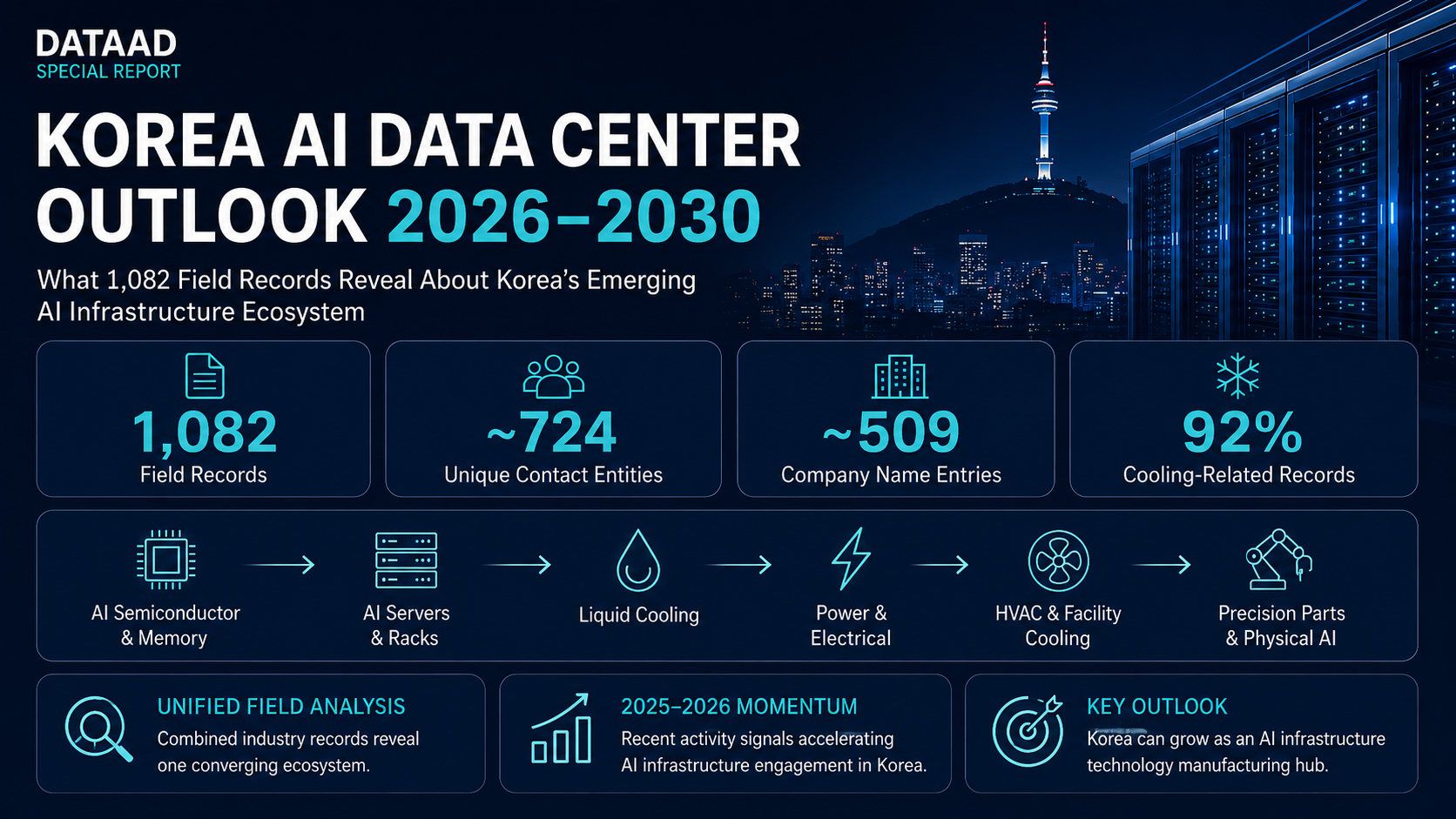
To explore that transition, DATAAD analyzed 1,082 proprietary field records collected through real-world industrial business activity in Korea.
| DATAAD Field Signal | Result |
|---|---|
| Raw Field Records | 1,082 |
| Estimated Unique Contact Entities | ~724 |
| Normalized Company-Name Entries | ~509 |
| Cooling-Related Records | 998 / 1,082 — about 92% |
Company-name counts vary slightly depending on normalization rules. These figures are preliminary field-analysis values, not audited market statistics.
This is not a formal market survey.
It is not market-share data.
It does not represent every company participating in Korea’s data-center industry.
The dataset is strongly influenced by liquid-cooling and thermal-management business activity.
But that bias itself reveals something interesting.
The Korean AI data-center discussion is rapidly becoming an industrial infrastructure discussion.
The network no longer consists only of IT companies.
It increasingly connects semiconductor companies, server manufacturers, data-center operators, HVAC companies, electrical suppliers, construction and engineering companies, pump manufacturers, fluid-system suppliers, precision component companies and advanced materials businesses.
DATAAD believes this convergence may define Korea’s next AI infrastructure cycle.
1. A Unified Field View of Korea’s AI Infrastructure Ecosystem
The most important signal in the 1,082 records is not simply the number of contacts.
It is the diversity of the industries appearing around the same technology problem.
The emerging ecosystem can be viewed as a connected chain:
AI Semiconductor & Memory → AI Servers & Racks → Liquid Cooling → Power & Electrical → HVAC & Facility Cooling → Precision Components → Physical AI
Historically, many of these industries operated separately.
A semiconductor company did not necessarily need to think about a building chiller.
An HVAC company did not necessarily need to understand GPU architecture.
A hose, valve or coupling supplier did not necessarily participate in IT infrastructure discussions.
AI is changing those boundaries.
When a rack consumes more power, it produces more heat.
When heat density rises, cooling must move closer to the processor.
When liquid enters the server rack, pumps, hoses, quick disconnects, manifolds, sensors and fluid quality become IT reliability issues.
And when hundreds of high-density racks operate together, the problem expands again into facility power and HVAC.
This is why DATAAD sees AI data centers increasingly as an industrial system, not simply an IT facility.
2. Cooling Is Becoming an Industry, Not a Single Product
Approximately 92% of the combined field records are associated with cooling-related activity.
This should not be interpreted as cooling representing 92% of Korea’s data-center market.
The underlying business network is intentionally concentrated around thermal and fluid technologies.
But it provides an unusually detailed view into the complexity of the emerging cooling ecosystem.
A modern direct-liquid-cooling architecture can include:
Cold Plate → Quick Disconnect → Hose → Server Manifold → Rack Manifold → CDU → Pump → Heat Exchanger → Facility Cooling → Chiller / HVAC
Each step represents a different engineering discipline.
The cold plate requires thermal design and precision manufacturing.
The quick disconnect requires low leakage, low pressure drop and reliable repeated connection.
The hose requires material compatibility, validated crimping and controlled routing.
The manifold requires flow distribution and pressure balancing.
The CDU requires pumps, heat exchangers, filtration, sensors and controls.
The facility then has to reject the heat through larger HVAC infrastructure.
What the industry casually calls “liquid cooling” is therefore becoming an entire supply chain.
3. What the Technical Conversations Reveal
A broad keyword scan of the technical notes contained in the field database gives another indication of where industry conversations are moving.
| Technology Signal | Approximate References |
|---|---|
| HVAC / Air Conditioning / Chiller | ~139 |
| OCP / UQD / BMQC and Related Interface Terms | ~83 |
| QD / Coupling | ~73 |
| Server | ~53 |
| Immersion Cooling | ~45 |
| AI / GPU | ~38 |
| Hose | ~16 |
| Two-Phase | ~11 |
| Manifold | ~8 |
| Cold Plate | ~7 |
| Explicit CDU References | ~5 |
The keyword groups overlap. A single record can contain several technologies, so these figures must not be interpreted as project counts or market share.
The direction is nevertheless useful.
The conversation is moving from:
Cooling Components
to:
Cooling Systems
and increasingly toward:
AI Thermal Infrastructure
4. Korea Is Moving From Data Centers to AI Factories
The conventional data center was largely understood as a building that contained IT equipment.
The AI factory changes this relationship.
Increasing power density forces the computing platform and the physical infrastructure to be designed together.
The architecture increasingly becomes:
GPU → Server → Rack → Network → Power → Cooling → Facility
The server can no longer be considered independently from the rack.
The rack can no longer be considered independently from power.
Power cannot be separated from heat.
And heat cannot be separated from the building.
This changes who participates in the data-center business.
Companies that historically sold electrical equipment, chillers, pumps, fluid components, precision-machined parts and industrial controls increasingly find themselves participating in the same AI infrastructure ecosystem.
The AI server is becoming industrial infrastructure.
5. Power May Redraw Korea’s Data Center Map
For many years, Korea’s data-center industry has been strongly concentrated around the Seoul metropolitan region.
That remains logical for enterprise computing, financial services, cloud connectivity and latency-sensitive applications.
Large-scale AI training introduces another consideration.
Electricity.
An AI facility measured in hundreds of megawatts cannot be located based on telecommunications access alone.
Its location increasingly depends on:
- Available grid capacity
- Land
- Power infrastructure
- Energy economics
- Cooling conditions
- Regional industrial ecosystems
DATAAD therefore expects Korea’s future AI infrastructure to become more geographically diversified.
The Seoul metropolitan region will remain important.
But large AI training infrastructure may increasingly follow power toward regional industrial and energy clusters.
The next Korean data-center map may be drawn as much by electricity as by telecommunications.
6. Large Korean Companies Are Entering the Same Thermal Ecosystem
The unified field dataset also contains an interesting signal from two large Korean industrial groups.
| Company | Raw Field Records | Estimated Unique Contact Entities |
|---|---|---|
| Company L | 56 | ~41 |
| Company S | 23 | ~21 |
These figures reflect DATAAD’s proprietary field network. They do not represent market share, revenue, purchasing intent or industry ranking.
Company L shows a particularly strong presence across the thermal-management side of this field network.
Company S also has a meaningful presence, although its engagement pattern in this specific dataset differs.
The important point is not whether Company L or Company S has the larger contact count.
The more interesting signal is that major Korean industrial groups are increasingly appearing inside a market connecting:
IT Cooling → CDU → HVAC → Facility Infrastructure
DATAAD expects this boundary to become strategically more important as rack power density continues to rise.
Repeating the same field analysis annually may eventually provide another useful indicator:
How quickly are Korea’s major industrial companies moving deeper into AI thermal infrastructure?
7. The Bigger Opportunity May Exist Below the Giants
The large-company signals are interesting.
But perhaps the most important finding in the 1,082 records is how many smaller and specialized companies appear around them.
The field network includes businesses related to:
- Precision machining
- HVAC engineering
- Pumps
- Heat exchangers
- Fluid systems
- Hoses
- Couplings and fittings
- Valves
- Sensors
- Electrical systems
- Rack components
- Construction
- Engineering services
- Materials
- Thermal technology
These businesses may never receive the public attention of semiconductor or cloud companies.
But AI infrastructure cannot operate without them.
A high-value GPU can still be stopped by a failed seal.
A powerful CDU cannot provide the required cooling if pressure loss through the distribution system is excessive.
A high-density rack cannot operate safely if hose routing, connection reliability or manifold balancing is poorly designed.
This creates a new industrial reality:
Small components can become mission-critical infrastructure.
8. Korea’s SME Opportunity Could Be Larger Than Expected
The digital economy often rewarded scale.
A software platform could add millions of users without manufacturing millions of new physical machines.
Physical AI is different.
A robot has to be manufactured.
An autonomous machine requires mechanical components.
A smart factory requires equipment.
An AI rack requires physical connections.
A liquid-cooling system requires pumps, seals, hoses and valves.
A high-density data center requires electrical and thermal infrastructure.
This may create a more distributed industrial opportunity.
AI may be dominated by giant technology platforms.
Physical AI may still require thousands of specialized manufacturers.
For Korea, this could be important.
The country already has a deep manufacturing base across automotive, machinery, electronics, shipbuilding, hydraulics, industrial automation and precision components.
Many companies may not need to become AI software businesses.
They may instead become suppliers to the physical infrastructure that AI requires.
9. The Opportunity Is Not Commodity Manufacturing
This opportunity does not mean every conventional manufacturer automatically becomes an AI winner.
The requirements are likely to become significantly more demanding.
Future suppliers will increasingly need:
- Precision
- Engineering capability
- Material knowledge
- Traceability
- Digital drawings and 3D CAD
- Testing records
- Lifecycle data
- Global standards compliance
- Rapid customization
- International technical communication
The progression for successful SMEs may therefore be:
Make to Print → Design to Requirement → Technology Ownership
That final step is important.
The largest long-term opportunity is not simply manufacturing somebody else’s drawing more cheaply.
It is developing a component, technology or manufacturing process that global AI infrastructure companies actually need.
10. A Robot Cannot Download a Bearing
There is a simple way to understand why Physical AI could matter to manufacturing.
A robot cannot download a bearing.
A data center cannot generate a manifold with software.
A liquid-cooling loop still requires a physical seal.
A server still needs a physical connector.
AI intelligence may be digital.
Its infrastructure is not.
AI may scale in software.
Physical AI must scale in manufacturing.
This distinction may give specialized manufacturers an opportunity that is very different from the software economy.
A small company can remain strategically important if it owns a difficult-to-reproduce physical technology.
In this environment:
Precision may matter more than company size.
11. The Next Industrial Interface May Be Designed for Robots
Physical AI may also change the design of ordinary industrial components.
Today, people install and service most hoses, cables, connectors and server modules.
Tomorrow, some of those tasks may increasingly be performed by machines.
A maintenance robot may eventually need to:
Locate → Identify → Grip → Align → Connect → Verify → Disconnect
That may create new design requirements:
- Repeatable gripping surfaces
- Self-alignment
- Machine-readable identification
- Visual recognition features
- Connection confirmation
- Standardized orientation
- Robot-accessible service space
This creates an interesting new manufacturing category:
Robot-Ready Components
A component that was originally designed entirely around the human hand may eventually need to be redesigned around machine vision, robotic gripping and automated verification.
12. Single-Phase DLC Is Building the First Infrastructure Layer
For the immediate market, DATAAD expects single-phase direct liquid cooling to remain the primary liquid-cooling architecture for mainstream high-density AI systems.
That transition is important for more than cooling today's GPUs.
It is teaching the entire industry how to operate liquid inside computing infrastructure.
The ecosystem is gaining experience with:
- Cold plates
- Quick disconnects
- Hose assemblies
- Rack manifolds
- CDUs
- Fluid quality
- Leak detection
- Maintenance procedures
- Interoperability
This industrial knowledge can become the foundation for whatever comes next.
DATAAD therefore views the current period broadly as:
2025–2027: Building the Liquid Infrastructure
13. The Dataset Already Contains Early Two-Phase Signals
A broad keyword scan identifies approximately 11 records containing explicit two-phase-related terminology.
This is a very small part of the overall dataset.
It clearly does not indicate that two-phase cooling is mainstream today.
In fact, the opposite conclusion is more appropriate:
the current commercial ecosystem remains overwhelmingly oriented toward single-phase liquid cooling.
But the existence of early two-phase conversations is still worth monitoring.
As future AI processors and racks move toward much higher thermal density, single-phase systems may face increasingly difficult challenges involving flow, pumping power, manifold scale and extreme chip heat flux.
DATAAD therefore does not view 2028 as a fixed technology-conversion date.
Instead:
2028–2030 may become an important market window to watch for selective Two-Phase DLC commercialization.
14. Two-Phase Could Create a Second Component Cycle
If Two-Phase DLC expands, the existing liquid-cooling ecosystem may evolve rather than disappear.
Today's architecture largely revolves around:
Water / Glycol → Cold Plate → Hose → QD → Manifold → CDU
A future two-phase architecture could increasingly involve:
Working Fluid → Evaporator → Refrigerant Interface → Liquid / Vapor Distribution → Condensation → Heat Rejection
This could create another technology market for:
- Low-GWP working fluids
- Advanced seal materials
- Low-permeation hoses
- Refrigerant-compatible fittings
- Vapor-compatible QDs
- Evaporator cold plates
- Condensers
- Pressure-control systems
- Fluid-recovery equipment
- Advanced thermal controls
This is particularly interesting for Korea because many of these requirements overlap with existing strengths in:
HVAC + Chemicals + Precision Machining + Electronics + Sensors + Pumps + Industrial Components
The second cooling cycle may therefore create new suppliers rather than simply replace first-generation technologies.
15. Korea Does Not Need to Become Taiwan
Taiwan has developed an extraordinary ecosystem around server and electronics manufacturing.
The United States remains extremely strong in AI compute architecture, semiconductors, software and cloud platforms.
Korea does not need to reproduce either model exactly.
Its industrial strengths are different.
Korea already possesses significant capabilities in:
- Semiconductors and memory
- Electronics
- HVAC and thermal systems
- Electrical infrastructure
- Automotive manufacturing
- Shipbuilding
- Industrial machinery
- Precision manufacturing
- Advanced materials
The opportunity may therefore be complementary rather than imitative.
16. Korea’s 2030 Opportunity: AI Infrastructure Technology Manufacturing
DATAAD believes Korea should not measure AI-data-center success only by asking:
How many data centers can Korea build?
Another question may ultimately be more important:
How many technologies inside the world’s AI data centers can Korea manufacture?
Consider a future AI rack.
The accelerator architecture may originate in the United States.
The server may come through a global manufacturing ecosystem.
But the:
- Memory
- Cold plate
- Hose
- Quick disconnect
- Manifold
- Sensor
- Pump
- Heat exchanger
- CDU
- Chiller
- Electrical component
- Control system
can potentially include technologies supplied by Korean companies.
And those products do not need to remain inside Korea.
They can be exported into AI infrastructure projects across North America, Japan, Southeast Asia, Europe, the Middle East and other markets.
That leads to a possible industrial positioning:
Korea as an AI Infrastructure Technology Manufacturing Hub
17. DATAAD Scenario: 2026–2030
2026–2027 — Liquid Infrastructure
Single-phase DLC continues to expand.
Cold plates, QDs, hoses, rack manifolds and CDUs become increasingly familiar.
Supply-chain qualification, reliability and field references become more important.
2027–2028 — Scale and Standardization
Rack density continues to increase.
Flow management, interoperability, fluid quality, pressure drop and serviceability become more important engineering issues.
Power availability increasingly affects where new AI infrastructure can be built.
2028–2030 — Advanced Thermal Systems
Two-phase DLC may begin to appear in selected ultra-high-density applications if economics, reliability, environmental requirements and standardization support adoption.
The traditional boundary between server cooling, CDU and HVAC could become less distinct.
2030+ — AI Infrastructure Meets Physical AI
Automation moves deeper into infrastructure operation and maintenance.
Robot-ready interfaces become increasingly valuable.
The data-center AI supply chain begins overlapping more strongly with robotics, autonomous machinery, factories, logistics, marine systems and other Physical AI markets.
18. Three Risks Could Slow the Opportunity
1. Power
The largest practical constraint may ultimately be electricity rather than demand for AI.
Without sufficient grid capacity, compute infrastructure cannot be deployed regardless of GPU availability.
2. Standards
Smaller suppliers will find scaling difficult if every rack uses completely different connectors, manifolds, fluids and maintenance architectures.
Interoperability and standardization will become increasingly important.
3. Technology Ownership
Even a rapidly growing AI market will not automatically create high-value businesses if Korean manufacturers remain only subcontractors producing foreign designs.
The larger opportunity requires:
Design + Application Engineering + IP + Testing Knowledge + Standards Participation + Exportable Technology
19. DATAAD Outlook
The strongest conclusion from the 1,082 field records is not that one company will dominate Korea’s AI data-center market.
It is that the number of industries touching the AI infrastructure ecosystem is expanding.
Semiconductor companies are meeting server companies.
Server companies are meeting cooling companies.
Cooling companies are meeting HVAC companies.
Electrical companies are meeting IT companies.
Precision manufacturers are entering discussions that once belonged mainly to computer engineers.
This is what industrial convergence looks like.
The first AI boom was largely about:
Models + GPUs + Cloud
The next phase adds:
Power + Cooling + Infrastructure
And Physical AI adds:
Machines + Components + Manufacturing
For Korea, that may be the larger opportunity.
Korea does not need to become the world’s largest data-center market.
It can aim to become one of the world’s most important manufacturing ecosystems for the technologies inside AI data centers and Physical AI systems.
Large corporations will matter.
Company L will matter.
Company S will matter.
Major platform, telecom, semiconductor and industrial groups will matter.
But the next AI infrastructure economy will not be built by large corporations alone.
Behind every AI rack are components.
Behind every robot are components.
Behind every autonomous machine are materials, sensors, connectors, actuators, bearings, hoses, seals and precision-manufactured parts.
Big AI could create a much bigger market for small, highly specialized industrial companies.
And that may be one of the most promising opportunities for Korean manufacturing between now and 2030.
Methodology & Disclosure
This DATAAD Special Report is based on three proprietary field datasets containing a combined 1,082 raw records collected through real-world industrial business activity.
The underlying records include business contacts, technical discussions, follow-up activity and project-related engagement.
Because the datasets overlap, 1,082 records do not represent 1,082 unique individuals.
A preliminary entity-matching process using normalized email addresses, mobile telephone numbers and company/person combinations produced approximately:
724 unique contact entities.
Preliminary company-name normalization results in approximately 509 company-name entries. The precise number can vary slightly depending on corporate-name normalization and group consolidation rules.
Approximately 998 of 1,082 raw records — about 92% — are cooling related.
After preliminary contact matching, approximately 660 of 724 unique contact entities — about 91% — are associated with at least one cooling-classified record.
The dataset contains substantial sampling bias toward liquid cooling, thermal management and fluid technology.
It therefore must not be interpreted as:
- Market share
- Revenue share
- Purchasing intent
- Industry-wide growth rate
- A statistically representative survey of Korea
Keyword counts are overlapping text-frequency indicators rather than independent project counts.
Personal names, email addresses, telephone numbers and individual consultation notes are not disclosed.
Selected large corporate participants derived from the proprietary field network are anonymized as Company L and Company S.
The forward-looking sections of this report represent DATAAD editorial analysis based on patterns observed in the proprietary field data. They should not be interpreted as guaranteed market forecasts.
DATAAD Special Report · August 2026
Proprietary Field-Network Analysis · Korea AI Data Center Outlook 2026–2030