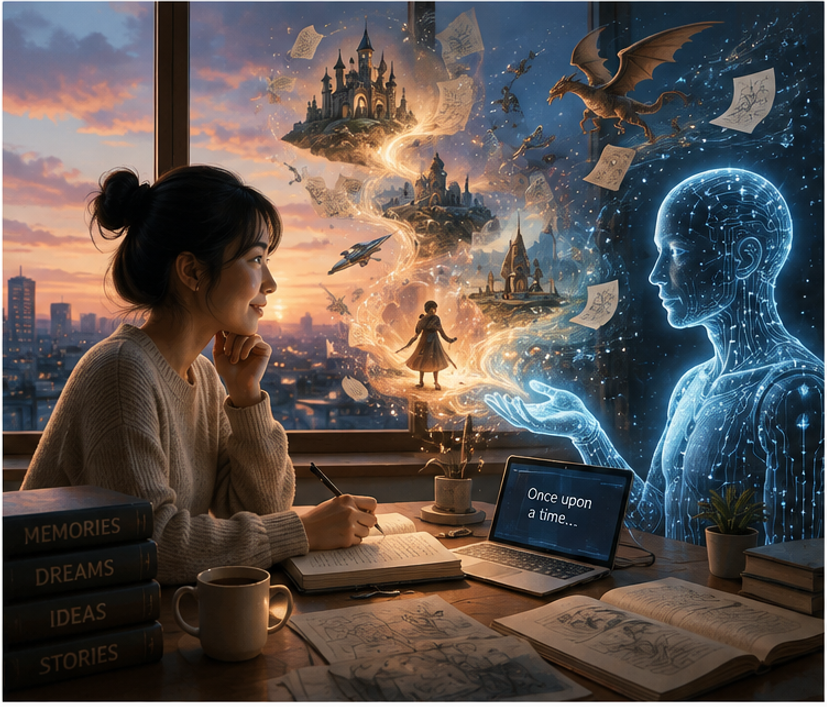
Artificial intelligence may know more than any individual human being.
But knowing is not the same as imagining.
An AI system can summarize thousands of books, explain physics, translate languages, analyze history and organize an enormous amount of accumulated human knowledge.
Yet the reason a new story begins is often much smaller and much more human.
A childhood memory.
A strange dream.
The death of someone we loved.
A conversation that never happened.
A fear about the future.
Or simply the question:
What if?
This distinction may become one of the most important ideas of the AI era.
AI brings knowledge.
Humanity brings imagination, experience and meaning.
The future does not necessarily have to be a competition between the two.
It may become a collaboration.
The AI Debate Is Often Too Extreme
Discussions about advanced AI frequently move toward extremes.
Will machines become more intelligent than humans?
Will AI replace most jobs?
Will machines eventually become indistinguishable from people?
Those questions may be intellectually interesting, but they can distract from something that is already happening today.
Millions of ordinary people suddenly have access to tools capable of helping them research, organize, translate, illustrate and develop ideas that previously required professional-level skills.
This is not a theoretical future.
It is already changing the practical cost of creation.
Most People Have Stories — Very Few Become Authors
Professional authorship has historically been a narrow field.
In the United States, for example, the Bureau of Labor Statistics counted about 135,400 jobs in the official “writers and authors” occupation in 2024. That figure does not include every person who writes independently or creatively, but it demonstrates how small formal authorship remains relative to the overall population.
Writing a novel traditionally requires several abilities at the same time:
- developing an idea,
- building characters,
- maintaining narrative structure,
- writing tens of thousands of words,
- editing repeatedly,
- formatting a manuscript,
- and eventually finding a route to publication.
Many people may have something meaningful to say but never develop all of these skills.
Their story therefore remains inside them.
What If the Missing 90% Is Not Missing Talent — but Missing Expression?
There is no statistical method that can measure how much human imagination remains unexpressed.
But consider it as a thought experiment.
What if what we currently publish represents only a small fraction of the memories, dreams, experiences and fictional worlds that people carry throughout their lives?
Perhaps the greatest untapped creative resource is not another database.
Perhaps it is the enormous amount of human experience that has never been expressed clearly enough to become a cultural work.
This is where generative AI could have a much more constructive role than simply producing endless synthetic content.
It can help people express what already exists inside them.
AI Should Not Replace the Imagination
This distinction matters.
There is an enormous difference between asking AI:
“Write me a random novel.”
and saying:
“I had this dream twenty years ago. I still remember the woman standing at the railway station. I don't know why it matters, but help me turn it into a story.”
In the first case, the machine originates most of the creative direction.
In the second, AI becomes a tool for developing something fundamentally human.
The memory belongs to the person.
The emotion belongs to the person.
The question belongs to the person.
AI contributes structure, language and knowledge.
The human should remain the source of meaning. AI can help make that meaning expressible.
Publishing Has Already Become More Accessible
Digital platforms have already reduced one major barrier to authorship: distribution.
Amazon Kindle Direct Publishing, for example, allows authors to self-publish digital and print books and distribute them internationally without first passing through a traditional publishing house.
KDP says its tools support publication in more than 45 languages across more than 10 countries.
This was a major democratization of publishing.
But it primarily solved a problem at the end of the process:
Once you have written the book, how do you publish it?
The Next Challenge Is Earlier: How Does an Ordinary Person Become a Creator?
The next generation of creative platforms may attack the problem much earlier.
Instead of asking for a completed manuscript, they may begin with a fragment.
A sentence.
A memory.
A dream.
A character.
A scene.
One example is Novelhaus, a U.S.-incorporated collaborative fiction platform.
Its workflow allows someone to begin with a story seed, receive community response, have contributors develop episodes, use AI to help structure qualified contributions, and return the manuscript to humans for editing and approval before publication.
Its stated mission is not simply to help existing writers write faster. It is to help more people become creators.
Novelhaus publicly describes a long-term ambition of enabling 10% of humanity to participate meaningfully in creation.
Why 10%?
Ten percent should not be understood as a forecast of the number of professional novelists.
It is better understood as a participation goal.
A creator does not necessarily need to write books full time.
A scientist could write one story.
A grandmother could preserve one memory.
An engineer could turn a strange idea into science fiction.
A teenager could create a fictional universe with people on another continent.
A retired worker could transform forty years of experiences into something another generation can understand.
The economic question is therefore much bigger than professional publishing.
It is:
Can AI expand the number of people who participate in the creative economy?
From Consumers to Creators
For most of modern media history, humanity has been divided into a relatively small group that produces stories and an enormous group that consumes them.
AI could begin to change that ratio.
The reader may also become a writer.
The viewer may become a storyteller.
The gamer may become a world-builder.
The audience may become a participant.
This could create new markets for publishing, collaborative fiction, games, animation, character IP and interactive entertainment.
But its cultural consequence may be even more interesting than its commercial consequence.
Stories Force Us to Enter Another Mind
A society does not become less divided simply because more people write stories.
But storytelling requires something that public debate increasingly lacks:
perspective.
To write a convincing character, we have to ask why another person thinks differently.
To create a conflict, we have to understand more than one side.
To build a world, we have to imagine consequences beyond our immediate experience.
Writing therefore creates at least an opportunity to move beyond the simple categories of:
us versus them.
One person's hero may be another person's villain.
One country's history may look completely different from another country's history.
One generation's common sense may seem incomprehensible to the next.
Stories allow us to explore those contradictions without requiring every question to have an immediate political winner.
More Creators Could Mean a Larger Human View of the Universe
Human beings have existed for only an instant on the scale of the universe.
Yet we frequently behave as if our current identities, nations, ideologies and disagreements represent the entire reality.
Creative work provides another possibility.
We can imagine civilizations that do not yet exist.
We can revisit people who have already died.
We can imagine living for a thousand years.
We can imagine meeting another intelligence.
We can imagine looking back at Earth from another planet.
We can ask what remains important when the normal assumptions of daily life disappear.
This may be one of the most valuable human roles in an age of increasingly capable AI.
The machine can extend what we know.
Humans can continue asking what it means.
Knowledge Plus Imagination
The healthiest relationship between AI and humanity may therefore be surprisingly simple:
AI = Knowledge Amplifier
Human = Imagination + Experience + Meaning
Together:
Knowledge + Imagination → Creation
This does not require humans to defeat AI.
It does not require AI to become human.
It requires each side to contribute what it does particularly well.
DATAAD Insight
The next creative revolution should not be measured by how many novels an AI can generate in one second.
That is an engineering achievement, but it is not necessarily a cultural achievement.
A more interesting measure may be:
How many humans who once believed they had nothing to write finally express something that only they could have imagined?
If AI allows creative participation to expand from a tiny minority toward millions — perhaps eventually hundreds of millions — the result could be an entirely new creative market.
But more importantly, it could create a larger archive of human memory, imagination and perspective.
AI can help humanity know more.
Humanity must still imagine what comes next.
DATAAD Insight: The 10% figure in this article is a creative-participation vision, not a forecast of professional-author employment. There is no authoritative global statistic establishing that exactly 0.2% of humanity are writers.