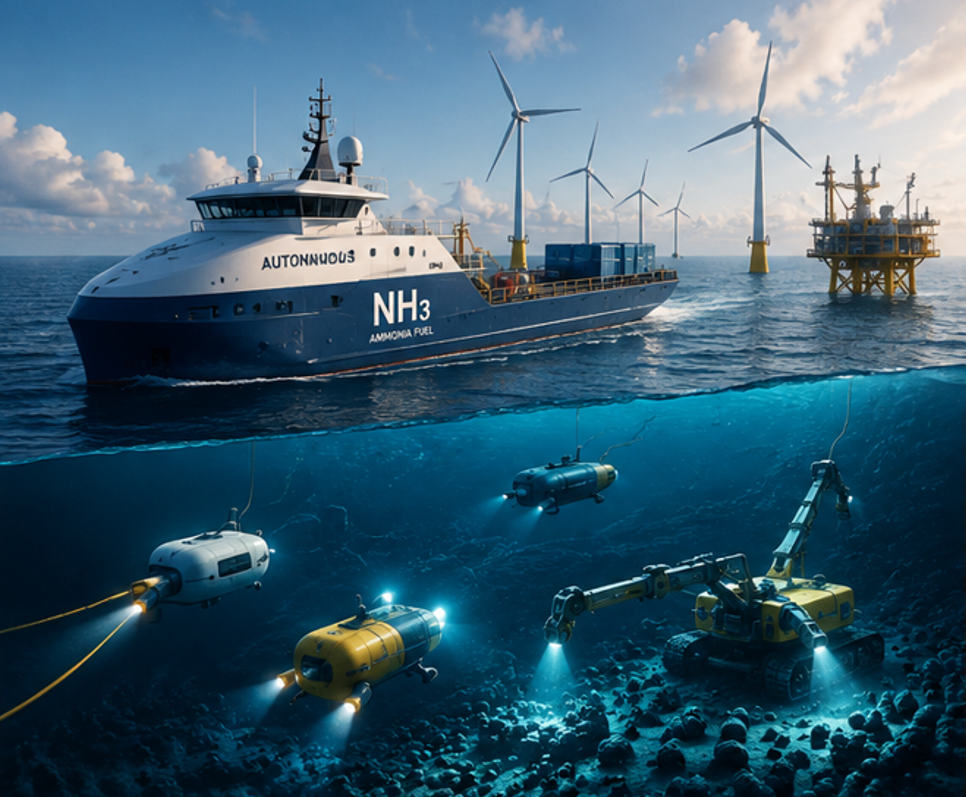
The next transformation of the ocean may not begin with a bigger ship or a bigger wind turbine.
It may begin with removing the human from places where humans are expensive, vulnerable or simply unable to work continuously.
Shipping is moving toward greater autonomy.
Marine propulsion is moving toward new fuels such as ammonia.
Underwater robots are becoming increasingly capable of surveying and working at extreme depths.
And offshore energy infrastructure is discovering that building equipment at sea is only half the challenge.
The other half is maintaining it for decades.
These trends point toward a much broader transition:
the ocean itself is becoming a field for Physical AI.
Shipping Is Moving Beyond the Conventional Crew Model
Autonomous shipping has spent years in demonstrations, pilot projects and regulatory discussions.
It is now beginning to move toward an international operating framework.
In May 2026, the International Maritime Organization adopted the first global non-mandatory MASS Code for Maritime Autonomous Surface Ships. The IMO's roadmap calls for work toward a mandatory code by 2030, with entry into force currently targeted for 2032.
This does not mean conventional crews will suddenly disappear.
But the direction is significant.
Navigation, machinery monitoring, condition-based maintenance, cargo handling and eventually some shipboard operations can increasingly be supervised by sensors, software, remote operators and autonomous systems.
The ship therefore begins to change from a crew-operated machine into a remotely supervised industrial platform.
The Fuel Is Changing at the Same Time
Autonomy is only one part of the transition.
The propulsion system is also changing.
Ammonia has emerged as one candidate for lower-carbon marine propulsion. The IMO has now approved interim safety guidelines for ships using ammonia as fuel, while classification and engine technologies continue to develop.
Ammonia is not an easy fuel.
Its toxicity, material compatibility, storage requirements and fuel-handling risks create engineering challenges that conventional marine fuels do not present in the same way.
This means the future vessel may require much more automation around:
fuel monitoring → leak detection → ventilation → valve control → emergency isolation → remote diagnostics.
New fuel therefore increases the need for intelligent automation rather than reducing it.
The Future Ship Could Become an Autonomous Energy Machine
Imagine a large commercial vessel operating with significantly fewer people in machinery spaces.
Pumps monitor themselves.
Valves report their position.
Hydraulic systems continuously analyze pressure and leakage.
Fuel systems detect abnormalities before they become incidents.
Robots perform routine inspection in areas that are hot, hazardous or difficult to access.
AI does not simply navigate the ship.
It begins to operate the entire physical system.
The autonomous ship will ultimately require more than autonomous navigation. It will require autonomous machinery.
But Autonomy May Eventually Move Below the Ship
The more interesting long-term development may happen beneath the waterline.
Autonomous underwater vehicles already perform seabed mapping and geological observation, while remotely operated vehicles allow operators on surface vessels to inspect and manipulate equipment deep underwater. NOAA describes AUVs as autonomous platforms capable of carrying sonar, cameras and geological sensors, while working-class ROVs have long been used in offshore industrial operations.
Today, these machines primarily explore, inspect and perform specialized subsea tasks.
The next step may be much larger.
A future offshore industrial platform could combine:
an unmanned or minimally crewed surface vessel + autonomous underwater vehicles + heavy-duty subsea robots + AI-controlled material handling.
From Exploration Vessel to Robotic Mining Platform
One possible application is deep-sea mineral development.
Mineral deposits exist thousands of meters below the surface, including polymetallic nodules containing manganese, nickel, copper and cobalt. At the same time, commercial deep-sea mining remains highly controversial because of potentially serious and long-lasting environmental impacts.
That environmental uncertainty should not be minimized.
Commercial-scale deep-sea mining has not yet become a mature global industry, and its regulatory future remains unsettled.
But from an engineering perspective, the direction is worth examining.
Humans cannot physically work at depths of 4,000 or 5,000 meters.
Machines must do the work.
That makes deep-ocean industrial activity inherently compatible with robotics and remote operation.
A future seabed-resource system may therefore look less like a traditional mining operation and more like an autonomous factory spread vertically through the ocean.
Surface mothership
↓
Subsea communications and power
↓
AUV survey fleet
↓
Robotic collection / excavation systems
↓
Automated material transport
↓
Remote AI operations center
This remains a future-looking scenario rather than today's commercial reality.
But it illustrates why marine robotics may eventually become one of the most demanding applications of Physical AI.
What About Offshore Wind?
Offshore wind has been one of the most visible new marine-energy industries of the past decade.
It will continue to have an important role.
But expectations should also remain realistic.
The International Energy Agency's 2025 renewable-energy outlook reduced its forecast for global offshore-wind growth over the following five years by more than 25%, citing higher costs, supply-chain challenges, policy changes and project delays.
This does not mean offshore wind is disappearing.
It means offshore wind is encountering the physical and economic realities of large-scale infrastructure.
The Turbine Is Only the Beginning of the Cost
A wind turbine at sea requires foundations or floating structures.
It requires subsea cables.
It requires grid connection.
It requires specialized installation vessels.
And after construction, it may need twenty years or more of inspection, repair and component replacement.
The U.S. Department of Energy's offshore-wind O&M roadmap highlights several of these challenges: rapidly increasing turbine and component size, immature new technologies, expensive unplanned maintenance, limited maintenance vessels and the inherent difficulty of performing maintenance at sea.
A 15–20 MW-class offshore turbine is an enormous machine.
A robot may inspect a blade.
A drone may identify surface damage.
An autonomous underwater vehicle may inspect the foundation or subsea cable.
AI may predict a gearbox problem.
But if a major component must actually be replaced, the industry may still need heavy vessels, cranes, technicians and a suitable weather window.
Robotics Can Reduce the Problem — Not Eliminate the Ocean
This distinction matters.
There is a tendency to assume that robots will make offshore maintenance easy.
They will certainly help.
Remote inspection, predictive maintenance, autonomous drones and robotic systems can reduce human exposure and improve monitoring.
The DOE itself identifies remote and autonomous maintenance as an important area of development.
But robotics cannot remove waves.
It cannot remove corrosion.
It cannot remove long transmission cables.
And it cannot eliminate the logistics involved in replacing a component weighing tens or hundreds of tonnes far from shore.
This means offshore wind may become increasingly sophisticated without necessarily becoming infinitely scalable or inexpensive.
The Bigger Opportunity May Be the Autonomous Ocean
The marine-energy discussion therefore should not be limited to one technology.
The ocean economy of the future could include autonomous commercial shipping, ammonia and other alternative fuels, offshore energy, subsea inspection, underwater infrastructure, seabed mapping, robotic resource exploration and remotely operated industrial platforms.
The common technology underneath these industries is not simply energy.
It is automation.
Sensors + Connectivity + Robotics + Fluid Power + Electrification + AI
Marine engineering and Physical AI may increasingly converge.
DATAAD Insight
For more than a century, the ship was one of the world's most important human-operated industrial machines.
The next generation may be fundamentally different.
The bridge may become more autonomous.
The engine room may become more automated.
The fuel may change.
Inspection robots may remain onboard.
And eventually the vessel may work together with autonomous machines operating thousands of meters below it.
At the same time, offshore wind reminds us of an important engineering reality:
the farther infrastructure moves from land, the more difficult maintenance becomes.
The winner in the next ocean economy may therefore not simply be the company that builds the largest ship, turbine or robot.
It may be the company that can make complex offshore systems operate reliably with fewer people, less intervention and better autonomous decision-making.
The future of the ocean may not simply be offshore.
It may be autonomous.
DATAAD Insight
Deep-sea mining remains environmentally and politically contested, and references to autonomous mining vessels represent a forward-looking engineering scenario rather than a prediction that commercial deployment is inevitable.