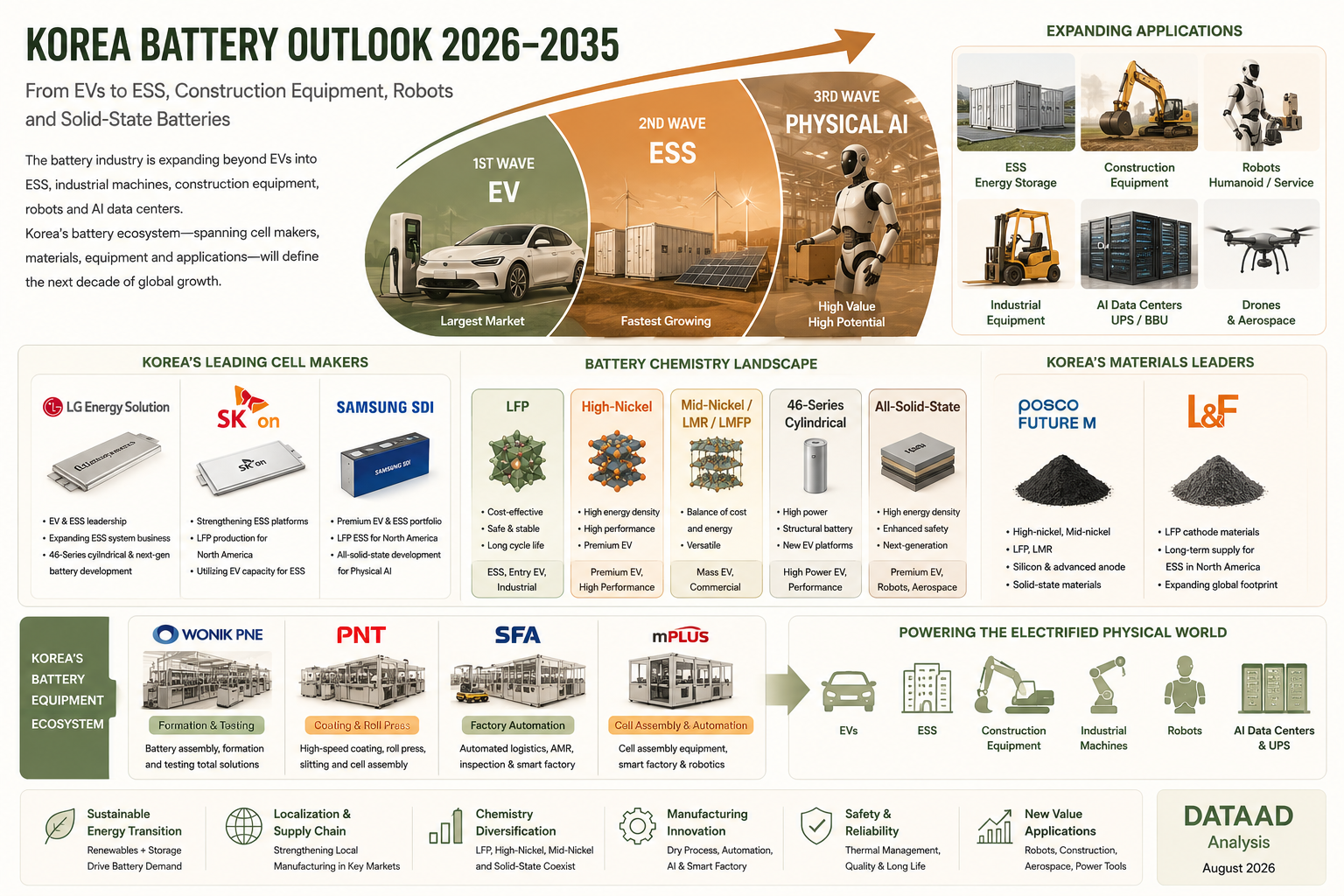
The global battery market is not moving from growth to decline.
It is moving from one dominant application toward many different applications.
For most of the past decade, the battery industry's central growth story was the electric passenger car.
EVs remain by far the largest battery market.
But another market is growing rapidly.
Energy Storage Systems — ESS — are becoming a major second pillar of global battery demand, driven by renewable energy, grid stability, AI data centers and industrial electrification.
At the same time, batteries are spreading into:
- AI data centers
- Construction equipment
- Forklifts and logistics equipment
- Industrial machines
- Humanoid and service robots
- Drones
- UPS and BBU systems
- Physical AI platforms
The result is no longer one battery market.
It is becoming a segmented battery economy.
For Korea, this creates a new opportunity.
Korea's competitive position no longer depends only on three large cell manufacturers.
It increasingly depends on a complete industrial ecosystem:
Materials → Cell → Manufacturing Equipment → Formation → Automation → Pack → End Application
This ecosystem includes major cell manufacturers such as LG Energy Solution, SK On and Samsung SDI, materials companies such as POSCO Future M and L&F, and manufacturing-equipment companies such as WONIK PNE, PNT, SFA and mPLUS.
DATAAD believes the Korean battery industry's next phase will be defined by five major changes:
- EV-centered growth becomes a multi-application battery market.
- LFP becomes strategically important for ESS and mass-market mobility.
- High-nickel and advanced lithium-ion chemistries remain important for high-performance applications.
- All-solid-state batteries initially target premium EVs and Physical AI rather than immediately replacing conventional lithium-ion batteries.
- Battery manufacturing equipment and automation become increasingly strategic.
1. The Global Battery Market Is Growing — But It Is Changing Shape
The battery industry experienced a difficult adjustment as EV growth became less uniform across regions.
That does not mean global battery demand has stopped growing.
Electric vehicles remain the largest battery application, but stationary energy storage is developing into another large market.
The market is therefore evolving from:
EV Battery Market
toward:
Energy + Mobility + AI + Industrial Battery Market
This distinction matters enormously for Korea.
Korean manufacturers invested heavily in EV battery plants around the world.
Those factories can increasingly become strategic manufacturing assets serving multiple applications rather than only passenger EVs.
2. China Still Defines the Competitive Benchmark
Any global battery outlook has to begin with China.
China has developed an enormous battery ecosystem spanning:
- Cell manufacturing
- Cathode materials
- Anode materials
- LFP chemistry
- Battery equipment
- Raw-material processing
- Pack manufacturing
This provides Chinese battery companies with significant advantages in:
Scale + Cost + Materials + Equipment + Supply-Chain Integration
Korean companies therefore face a difficult strategic question.
Simply manufacturing the same commodity battery at the same cost as China's integrated ecosystem may not be sufficient.
DATAAD believes Korea needs a more segmented strategy:
Localized Supply Chain + Chemistry Diversification + Quality + Safety + Performance + Application Engineering
3. The Battery Chemistry Map Is Splitting Into Several Markets
One terminology issue is important.
LFP is itself a lithium-ion battery chemistry.
The future market should therefore not be described simply as:
LFP vs. Li-ion
A more useful market framework is:
| Battery Technology | Potential Strength |
|---|---|
| LFP | ESS, entry-level EV, cost, safety and long cycle life |
| High-Nickel NCM / NCA | Premium EV, high energy density and high performance |
| Mid-Nickel / LMR / LMFP | Balance between cost and energy density |
| 46-Series Cylindrical | High-power and advanced EV platforms |
| Sodium-Ion | Potential stationary and cost-sensitive applications |
| All-Solid-State | Premium EV, robots, aerospace and advanced Physical AI |
The future is unlikely to be one chemistry replacing every other chemistry.
The right battery will increasingly depend on the application.
4. LFP Is Becoming the Battery of Stationary Energy
ESS is one of the clearest examples of battery-market segmentation.
LFP offers several characteristics that are particularly attractive for stationary applications:
- Relatively low cost
- Good thermal stability
- Long cycle life
- Reduced dependence on nickel and cobalt
In a stationary battery system, size and weight are generally less restrictive than inside a passenger vehicle.
This changes the optimization priority.
An ESS battery can focus heavily on:
Cost + Safety + Cycle Life
rather than maximizing energy density at almost any cost.
This is strategically important because ESS demand is being driven simultaneously by:
- Renewable-energy integration
- Grid stability
- AI data centers
- UPS systems
- Industrial loads
- Energy resilience
The future battery market therefore does not simply follow the number of EVs sold.
It increasingly follows the transformation of the electricity system itself.
5. LG Energy Solution: From EV Batteries to Energy Infrastructure
LG Energy Solution provides a clear example of strategic diversification.
The company continues to operate as one of the world's major EV battery manufacturers while expanding aggressively into ESS.
The important change is not simply the number of cells produced.
The business model is moving toward:
Cell → Pack → ESS System → Software / Energy Management
This potentially transforms a battery manufacturer into a broader energy-infrastructure company.
At the same time, LG Energy Solution continues developing cylindrical and advanced EV batteries rather than abandoning mobility.
DATAAD expects this to become a common pattern:
Diversification, not withdrawal from EVs.
6. SK On: EV Capacity Can Become an ESS Asset
SK On is also expanding beyond its traditional EV-centered business.
The company is strengthening ESS platforms and LFP capabilities for markets including grid storage and AI infrastructure.
This highlights an important structural advantage.
Battery manufacturing capacity does not necessarily become useless when demand changes.
Part of an EV-oriented manufacturing base can potentially be:
Converted → Reconfigured → Rebalanced
toward other applications such as ESS.
That flexibility may become increasingly important as battery markets experience different demand cycles.
7. Samsung SDI: Premium EV + ESS + Physical AI
Samsung SDI is following a somewhat different strategy.
The company has historically emphasized high-performance batteries and premium mobility applications.
But it is also expanding into LFP ESS while maintaining advanced EV technologies.
At the same time, Samsung SDI is one of Korea's most visible developers of all-solid-state batteries.
This creates an interesting long-term portfolio structure:
LFP for ESS
Advanced Lithium-Ion for Premium EV
All-Solid-State for Premium Mobility and Physical AI
That may provide an early view of how battery companies operate in the 2030s.
8. Solid-State Will Not Replace Lithium-Ion Overnight
All-solid-state batteries receive enormous attention.
The technology offers potential advantages including:
- Higher energy density
- Improved safety potential
- Advanced anode designs
- Compact packaging
But commercialization should be viewed carefully.
Conventional lithium-ion manufacturing has decades of accumulated scale, process knowledge and cost reduction behind it.
Solid-state batteries will have to overcome challenges involving:
- Manufacturing cost
- Solid electrolyte handling
- Interface resistance
- Pressure management
- Yield
- Cycle life
- Mass-production equipment
DATAAD therefore does not expect solid-state batteries to suddenly replace conventional lithium-ion cells across every application.
Initial commercial markets are more likely to focus on applications where high energy density, safety and space justify additional cost.
Examples could include:
Premium EV → Humanoid Robot → Aerospace / UAM → Specialized Industrial Mobility
Mass-market ESS is far more likely to remain dominated by lower-cost chemistries such as LFP for a considerable period.
9. Robots Could Become a High-Value Battery Market
Robots may initially consume far fewer gigawatt-hours than EVs or grid ESS.
But they could become one of the most technologically demanding battery applications.
Humanoid robots have limited internal space.
They require long operating time.
They repeatedly accelerate and decelerate.
They may work directly beside people.
The battery therefore needs an unusual combination of:
Energy Density + Low Weight + High Power + Safety + Fast Replacement
This is very different from grid ESS.
ESS optimizes:
Cost + Cycle Life + Safety
Robotics may optimize:
Weight + Energy Density + Power + Safety
Different applications naturally create different winning battery technologies.
DATAAD therefore sees robotics as:
Low Volume First → High Value First → Potentially High Volume Later
10. Construction Equipment Is Another Emerging Battery Market
Construction equipment is another underestimated battery application.
Its operating conditions can be significantly more demanding than those of passenger vehicles.
Machines face:
- Vibration
- Shock
- Dust
- Extreme temperatures
- Long working hours
- High transient power demand
The battery pack therefore has to become an industrial component rather than simply an automotive derivative.
Korean construction-equipment manufacturers are already exploring standardized modular battery architectures with Korean battery companies.
This can lead toward:
Standard Battery Module → Configurable Pack → Multiple Machine Platforms
A modular approach could allow the same basic battery technology to serve:
- Compact excavators
- Loaders
- Forklifts
- Tractors
- Landscape equipment
- Industrial machines
This could create significant economies of scale outside passenger EVs.
11. Battery Thermal Management Becomes More Important Outside Passenger EVs
As battery applications diversify, thermal management becomes increasingly specialized.
Construction equipment operates under heavy loads and harsh environmental conditions.
Robots continuously vary power demand.
ESS systems operate for many years.
AI data-center batteries may need to respond immediately to power disturbances.
The thermal-management requirements therefore change by application.
A battery system may increasingly require:
- Liquid cooling
- Cold plates
- Pumps
- Hoses
- Quick disconnects
- Temperature sensors
- Flow control
- Advanced BMS thermal algorithms
More battery power density eventually creates a thermal-management market.
12. Materials: POSCO Future M Is Building a Multi-Chemistry Portfolio
Korea's battery opportunity is not limited to cell production.
Materials remain one of the most strategically important layers.
POSCO Future M has built a significant position across cathode and anode materials.
The future portfolio is becoming more diversified.
Potential material directions include:
- Ultra-high-nickel cathodes
- Mid-nickel materials
- LMR
- LFP
- Advanced graphite anodes
- Silicon-based anodes
- Materials relevant to solid-state batteries
This is exactly what a segmented battery market requires.
No single chemistry serves every application.
The materials company therefore has to follow the battery manufacturer into a multi-chemistry world.
13. L&F and the Localization of Korea's LFP Supply Chain
L&F is another strategically important Korean cathode-material supplier.
As Korean battery manufacturers increase their LFP production, domestic LFP cathode-material capability becomes more important.
The strategic direction is moving away from:
Import Battery Chemistry
toward:
Localize Cell + Material + Manufacturing
This can become particularly important in North America and other markets where local supply-chain requirements increasingly influence investment decisions.
14. The Hidden Winners May Be Battery Equipment Companies
A battery cannot be manufactured at scale without specialized manufacturing equipment.
A simplified battery production flow can be viewed as:
Electrode → Cell Assembly → Formation → Inspection → Module / Pack
Each process requires:
- Precision machinery
- Automation
- Inspection
- Process control
- Quality management
This matters because new battery chemistries do not simply require new materials.
They can require entirely new manufacturing processes.
Solid-state batteries are an especially important example.
Dry electrode processing, solid electrolyte handling, high pressure and different stacking techniques could change the architecture of future battery factories.
When battery chemistry changes, battery equipment changes too.
15. WONIK PNE: Formation Becomes a Strategic Process
WONIK PNE is one of Korea's battery manufacturing and testing equipment specialists.
The company provides solutions covering battery assembly, formation and testing.
Formation is sometimes less visible than coating or cell assembly.
But it is a critical part of battery manufacturing.
After assembly, cells must go through carefully controlled charging and discharging processes.
This process helps establish and verify electrochemical performance.
Formation and testing increasingly contribute to:
- Capacity verification
- Quality control
- Safety verification
- Cell sorting
- Yield improvement
- Lifetime prediction
Future factories may increasingly use formation data not simply to accept or reject a cell, but to predict its future behavior.
This creates a natural intersection between:
Formation Equipment + Battery Data + AI Quality Control
16. PNT: Yield at Speed
PNT represents another important part of the Korean battery-equipment ecosystem.
Its manufacturing technologies include processes such as:
- Electrode coating
- Roll pressing
- Slitting
- Cell manufacturing equipment
- Formation-related systems
The challenge in future battery manufacturing is not simply producing a high-quality cell.
It is producing that cell at enormous scale and competitive cost.
Yield matters.
Yield at speed matters more.
The manufacturing-equipment competition is increasingly about:
Speed + Precision + Automation + Yield + Energy Efficiency
17. SFA: Battery Manufacturing Becomes an Automated Logistics System
SFA represents another layer of the battery industry: factory automation and logistics.
Large battery plants require much more than production machines.
Materials and cells must move through the factory automatically.
Future plants increasingly require:
- AMRs
- Automated warehouses
- Machine vision
- Digital tracking
- Robotic handling
- Inline inspection
- Predictive maintenance
The battery factory therefore begins to resemble a large Physical AI system.
18. mPLUS: From Machine Builder to Manufacturing System Integrator
mPLUS provides battery manufacturing equipment while also expanding into smart-factory and robotic technologies.
This represents an important transformation in the equipment business.
The old model was:
Machine Builder
The emerging model is:
Manufacturing System Integrator
Battery producers increasingly need equipment partners capable of understanding:
Process + Automation + Data + Robotics + Quality + Next-Generation Chemistry
This may increase the strategic value of specialized Korean equipment companies.
19. EV Will Still Be the Largest Battery Market
The rise of ESS should not be confused with the disappearance of EV battery demand.
EV remains the largest global battery application.
But the EV market itself is becoming segmented.
Premium vehicles may prioritize:
Range + Energy Density + Fast Charging
Mass-market vehicles may prioritize:
Cost + Safety
Commercial vehicles may prioritize:
Cycle Life + Durability
Performance vehicles may prioritize:
Power
This is another reason multiple battery chemistries are likely to coexist.
20. ESS May Become the Second Great Battery Market
If EV was the first great lithium-ion battery market, ESS may become the second.
The underlying demand drivers are structural:
- Renewable power
- Grid congestion
- AI data centers
- Electricity-price volatility
- Distributed generation
- Energy resilience
For Korean manufacturers, ESS is particularly important because it allows battery-manufacturing assets to participate in another large global market.
The future battery factory may become more flexible:
EV + ESS + Industrial Applications
rather than being permanently tied to one end market.
21. AI Data Centers Could Create a New Battery Category
AI data centers create battery applications that sit between conventional ESS and high-power industrial batteries.
Examples include:
- Grid-scale BESS
- UPS batteries
- Battery Backup Units inside server infrastructure
- Power-quality support
- Microgrid systems
These applications have different operating requirements.
A grid battery may need to provide energy for several hours.
A BBU may need to deliver extreme power almost immediately.
This creates another important distinction:
Energy Battery vs. Power Battery
Again, one battery architecture cannot optimize every application.
22. DATAAD Battery Demand Map
| Application | Primary Requirement | Likely Battery Direction |
|---|---|---|
| Mass-Market EV | Cost + Safety | LFP / Mid-Nickel / LMR |
| Premium EV | Range + Energy Density | High-Nickel / 46-Series / Future ASSB |
| Grid ESS | Cost + Cycle Life + Safety | LFP / Potential Sodium-Ion |
| AI Data Center ESS | Safety + Availability + Local Supply | LFP |
| UPS / BBU | High Power + Fast Response | High-Power Li-ion |
| Construction Equipment | Ruggedness + Power + Modular Packs | Application-Specific Li-ion / LFP |
| Robots | Weight + Energy Density + Power | Advanced Li-ion → Future ASSB |
| Aerospace / UAM | Extreme Energy Density | Advanced Li-ion / ASSB |
| Industrial Machines | Reliability + Long Life | Application-Specific Li-ion / LFP |
The key word is:
Segmentation.
23. Korea's Competitive Advantage Is the Full Value Chain
China currently possesses the largest and most integrated battery industrial ecosystem.
Korea cannot ignore that reality.
But Korea possesses another valuable combination of capabilities.
Cell Manufacturers
LG Energy Solution
SK On
Samsung SDI
Materials
POSCO Future M
L&F
Cathode, anode, separator, electrolyte and specialty-material suppliers
Manufacturing Equipment
WONIK PNE
PNT
SFA
mPLUS
Specialized automation, inspection and process-equipment suppliers
End Applications
Automotive
Construction Equipment
Industrial Machinery
Robotics
Electronics
AI Data Centers
This gives Korea an opportunity that extends beyond battery-cell manufacturing.
The larger opportunity may be to build a Battery Technology Manufacturing Ecosystem.
24. The Equipment Layer Could Become More Valuable in the Solid-State Era
This may be one of the most interesting long-term opportunities.
A new battery chemistry does not merely change the active material.
It can change:
- Mixing
- Coating
- Drying
- Pressing
- Stacking
- Formation
- Inspection
- Factory humidity requirements
- Automation
- Quality control
Dry-electrode processes are particularly interesting because removing or reducing conventional wet coating and drying steps could significantly change manufacturing-line architecture.
If solid-state batteries reach mass production, new equipment requirements may emerge across the entire factory.
The winners of the solid-state era may include companies that never manufacture a battery cell.
25. The Battery Factory Itself Will Become Physical AI
Battery manufacturing is especially suitable for deeper automation.
The processes are repetitive.
Quality is measurable.
Machines generate enormous quantities of data.
Failures are expensive.
Future factories may increasingly combine:
Machine Vision + AMR + Inline Inspection + Digital Twin + AI Quality Prediction + Predictive Maintenance + Autonomous Robots
The objective is not simply to remove people.
The economic objective is:
Higher Yield + Higher Speed + Lower Cost + Higher Safety
The battery factory itself therefore becomes another major Physical AI market.
26. DATAAD Scenario: 2026–2035
2026–2027 — The ESS Rebalancing
Korean battery manufacturers continue diversifying part of their manufacturing capacity toward ESS.
LFP localization accelerates.
North American manufacturing and local supply chains remain strategically important.
Formation, automation and battery-equipment companies benefit from conversions and new investment.
2027–2030 — Chemistry Segmentation
LFP becomes deeply established in ESS and cost-sensitive applications.
High-nickel remains important for premium mobility.
Mid-nickel, LMR and other chemistries compete for the middle ground.
Initial solid-state commercialization begins if current development targets are achieved.
2030–2035 — Application Segmentation
Battery design increasingly follows the machine.
The industry begins talking less about simply “the battery market” and more about:
- EV batteries
- Robot batteries
- Construction-equipment batteries
- AI data-center batteries
- Grid batteries
- Aerospace batteries
The word “battery” becomes less useful without specifying the application.
27. Five Risks Korea Must Manage
1. Chinese Cost Leadership
China remains extremely difficult to compete with in commodity battery manufacturing and LFP supply chains.
2. Overcapacity
If investment runs significantly ahead of EV and ESS demand, price pressure can become severe.
3. Raw-Material Dependence
Korean cell production remains dependent on global supply chains for lithium, graphite and other strategic materials.
4. Solid-State Timing
Solid-state commercialization may develop more slowly than optimistic roadmaps currently suggest.
5. Equipment Commoditization
Korean battery-equipment companies must avoid becoming low-margin build-to-print suppliers.
The larger opportunity requires:
Process IP + Automation + Data + Global Service + Technology Ownership
28. DATAAD Outlook
The battery industry's first great growth phase was built around the electric vehicle.
The second phase will be much broader.
It will include:
EV + ESS + AI Data Centers + Construction Equipment + Robots + Industrial Machines + Aerospace
At the same time, battery technology itself is splitting into several directions.
LFP for cost and cycle life.
High-nickel for high performance and energy density.
Mid-nickel and LMR for balance.
All-solid-state for applications that can justify extreme performance and additional cost.
The Korean industry's greatest strength may therefore not be one chemistry.
It may be the ability to connect:
Materials → Cells → Equipment → Automation → Pack → End Application
LG Energy Solution, SK On and Samsung SDI will remain central.
But they will not build the next battery economy alone.
POSCO Future M and L&F will matter.
WONIK PNE, PNT, SFA and mPLUS will matter.
Pack manufacturers will matter.
Thermal-management companies will matter.
Robotics companies will matter.
Construction-equipment companies will matter.
And thousands of precision suppliers may eventually participate.
The strategic transition can be summarized simply:
The battery industry is moving from “batteries for EVs” to “batteries for the electrified physical world.”
That could be especially important for Korea.
Korea is not only a battery-cell manufacturing country.
It is also a country of:
Materials.
Machines.
Factories.
Construction equipment.
Electronics.
Robots.
Precision manufacturing.
The rise of Physical AI may therefore expand the battery opportunity rather than narrow it.
EV created the first global battery boom.
ESS may create the second.
Physical AI could create the third.
Editorial Note
LFP is a type of lithium-ion battery and should not be interpreted as a technology separate from lithium-ion batteries.
The battery-market scenarios in this report distinguish between technologies already in mass production and next-generation technologies still moving through pilot and commercialization stages.
All-solid-state battery timelines represent current industry and corporate development targets and should not be interpreted as guaranteed commercialization schedules.
The future application and chemistry mappings presented in this report are DATAAD editorial analysis rather than market-share forecasts or investment recommendations.
DATAAD Special Report · August 2026
Korea Battery Outlook 2026–2035 · Energy & EV