How Much Power Does an AI Data Center Really Use?
Artificial intelligence may run in software, but the unit that increasingly determines its scale is the megawatt.
When people hear that an AI data center consumes enormous amounts of electricity, the numbers can be difficult to understand.
What does 100 kW per rack actually mean?
How does that become a 100 MW or 500 MW data-center campus?
And why are technology companies suddenly discussing power plants, transmission grids and nuclear energy?
The easiest way to understand the problem is to start small.
Start with one rack.
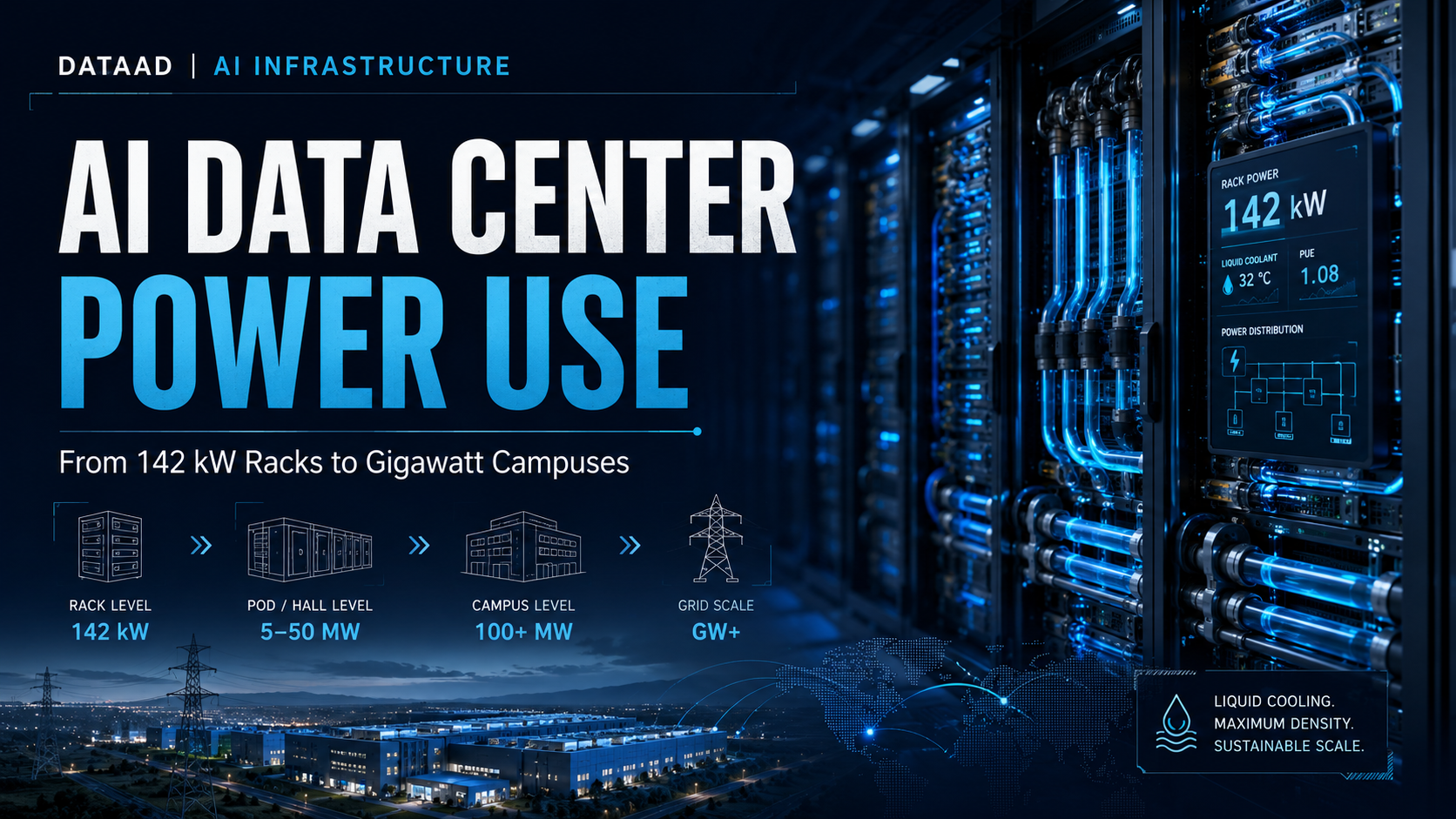
One Modern AI Rack Can Consume More Than 100 kW
Traditional enterprise data-center racks were often designed around much lower power densities.
AI changes that dramatically.
NVIDIA's current GB300 NVL72 rack-scale platform integrates 72 Blackwell Ultra GPUs and 36 Grace CPUs in a fully liquid-cooled architecture. NVIDIA's own reference architecture specifies that a complete GB300 NVL72 rack can require up to approximately 142 kW of power.
That is only one rack.
Imagine placing ten of them together.
10 racks × 142 kW = approximately 1.42 MW
One hundred racks would approach:
14.2 MW of IT load.
And that calculation does not yet include every electrical and cooling load required to operate the data center.
IT Power Is Not the Same as Facility Power
The processors are only part of the electricity bill.
A data center also needs power for:
- cooling equipment,
- CDUs and pumps,
- fans,
- power conversion,
- UPS systems,
- networking,
- lighting,
- controls,
- and other facility infrastructure.
This is why the industry uses PUE — Power Usage Effectiveness.
A PUE of 1.20 means that for every 1.0 watt used by IT equipment, roughly another 0.20 watt is required by the rest of the facility.
So a hypothetical 100 MW IT load at PUE 1.20 would require approximately:
120 MW from the facility power system.
From Kilowatts to Megawatts
The scale becomes easier to understand when the units are separated.
1,000 watts = 1 kilowatt
1,000 kilowatts = 1 megawatt
1,000 megawatts = 1 gigawatt
A modern AI rack therefore operates in the 100+ kW class.
A cluster of racks quickly reaches multiple megawatts.
A large AI data center can reach hundreds of megawatts.
And very large AI campuses are increasingly discussed in gigawatt-scale terms.
What Does 100 MW Mean Over a Full Year?
Power is instantaneous.
Energy is power multiplied by time.
If a 100 MW facility operated continuously at full load:
100 MW × 24 hours = 2,400 MWh per day
Over a year:
approximately 876 GWh of electricity.
A hypothetical continuously loaded 500 MW campus would consume approximately:
4.38 TWh per year.
Real facilities do not necessarily operate continuously at full nameplate capacity, but the calculation demonstrates the scale of the infrastructure problem.
The United States Is Already Feeling the Impact
According to the U.S. Department of Energy and Lawrence Berkeley National Laboratory, data centers consumed roughly 4.4% of total U.S. electricity in 2023.
The earlier DOE/LBNL outlook estimated that this share could rise to approximately 6.7% to 12% by 2028. A subsequent Berkeley Lab update estimated that data centers could account for around 11.8% of U.S. electricity consumption by 2030, with scenarios ranging from 9.5% to 15.3%.
This explains why data-center projects are increasingly discussed not only by technology companies, but also by utilities, grid operators and governments.
The Global Story Is Even Larger
The International Energy Agency projects global data-center electricity consumption to roughly double by 2030, reaching around 945 TWh in its base case.
From 2024 to 2030, the IEA expects data-center electricity consumption to grow by around 15% per year — more than four times the growth rate of electricity demand from other sectors combined.
The IEA also reported that global data-center electricity demand rose approximately 17% in 2025, with AI-focused facilities growing even faster.
AI therefore represents more than a new computing workload.
It is beginning to reshape electricity demand itself.
Why Does AI Need So Much More Power?
There are several reasons.
First, the processors themselves are becoming more powerful.
Second, more processors are being connected into larger clusters.
Third, modern AI workloads run highly parallel calculations for training and increasingly for large-scale inference.
Fourth, networking, memory and storage must scale with the processors.
And finally, every watt entering the electronics eventually becomes heat that must be removed.
This creates a simple equation:
More AI Compute → More Electricity → More Heat → More Cooling Infrastructure
Power and Cooling Are Becoming the Same Planning Problem
Historically, the data-center power engineer and cooling engineer could often work as relatively separate disciplines.
AI makes that increasingly difficult.
A 142 kW rack cannot simply be installed because floor space is available.
The facility must also provide:
- 142 kW-class electrical distribution,
- appropriate busbars and power shelves,
- liquid cooling capacity,
- rack manifolds,
- CDU capacity,
- and facility heat rejection.
The electrical and thermal architecture must therefore be planned together.
This Is Why Liquid Cooling Matters
The NVIDIA GB300 NVL72 itself is a useful example.
NVIDIA describes the platform as a fully liquid-cooled rack-scale architecture.
At this density, moving the heat through air alone becomes increasingly impractical.
Liquid cooling allows heat to be removed closer to the GPU and CPU and transported through a much smaller physical flow volume than air.
But liquid cooling does not reduce the fundamental amount of heat created by the compute.
It provides a more effective way to move that heat.
Future Rack Density Makes the Question Even More Important
The current generation is unlikely to represent the upper limit.
NVIDIA's next-generation platforms continue to move toward more integrated rack-scale systems, and the industry is preparing for even higher heat flux and power density.
This is why cooling technologies such as advanced single-phase DLC and two-phase direct-to-chip systems are receiving increasing attention.
The challenge is no longer simply:
Can we cool the GPU?
It is:
Can the entire rack, data hall and electrical system support the next generation of compute density?
The Bigger Constraint May Be the Grid
A server company can manufacture more racks relatively quickly.
A utility cannot necessarily build a new substation, transmission line or power plant at the same speed.
The U.S. Department of Energy has noted hyperscale facility connection requests in the 300 MW to 1,000 MW or larger range.
At that level, the project is no longer only a building.
It becomes part of the regional energy system.
This Is Why Big Tech Is Looking at Nuclear Power
AI data centers need enormous amounts of electricity, but they also need that electricity continuously.
This makes 24/7 generation particularly valuable.
The IEA expects nuclear power to play a growing role in supplying data-center electricity toward the end of this decade and beyond.
This does not mean nuclear will power every AI data center.
Renewables, natural gas, grids, storage and other sources will all remain important.
But the return of nuclear power to technology-industry strategy is directly connected to the scale and reliability requirements of AI infrastructure.
A Simple Way to Think About AI Data-Center Power
For a general reader, the following ranges help explain the scale:
| Level | Illustrative Power Scale | What It Represents |
|---|---|---|
| AI GPU / Processor | Hundreds of watts to kW-class | Individual accelerator |
| AI Server | Several kW to tens of kW | Multiple accelerators + CPUs + memory |
| AI Rack | 100 kW+ | Rack-scale AI system |
| AI Cluster | Several MW to tens of MW | Multiple rack-scale systems |
| Large AI Data Center | 100 MW+ | Major AI training/inference facility |
| AI Campus | Hundreds of MW to potential GW scale | Multiple buildings and large energy infrastructure |
These ranges are illustrative rather than universal. Actual power depends on compute architecture, utilization, redundancy, cooling method and facility design.
The Important Number Is Not Just MW
When evaluating an AI data-center project, power capacity alone is not enough.
The more important questions are:
How much usable compute can be produced per megawatt?
How much electricity is consumed by cooling rather than computing?
How much rack density can the facility physically support?
How reliably can the grid supply the site?
How quickly can additional power capacity be built?
This is why energy efficiency, cooling efficiency and processor efficiency are becoming economically connected.
DATAAD Insight
The AI industry's most visible metric has traditionally been compute performance.
But as AI infrastructure grows, another metric is becoming equally important:
megawatts.
A powerful GPU is useful only if electricity can reach it.
A rack-scale system is useful only if a facility can power and cool it.
And a 500 MW AI campus is useful only if the regional energy system can support it.
The next AI bottleneck may not be how many GPUs can be manufactured.
It may be how many megawatts can be delivered, cooled and operated reliably.
This is why AI is no longer only a semiconductor industry.
It is becoming an electricity and infrastructure industry.
DATAAD Guide
Key source basis: NVIDIA GB300 NVL72 documentation, U.S. Department of Energy / Lawrence Berkeley National Laboratory data-center energy reports, and International Energy Agency Energy and AI analysis. Power examples are intended to explain scale and should not be interpreted as universal facility-design values.